Archives

5th VISION annual conference: Presentations and illustrations now available

The fifth VISION annual conference was held on 7 July at The Light Auditorium in Friends House. The theme was Violence prevention in dialogue: Research and Policy.

After five years of research looking at violence prevention and the resulting health inequalities and focusing on improved measurement, policy, and practice, and delivering through a strong cross-sector partnership, we showcased our research in partnership with stakeholders Refuge, High Trees, Migrants’ Rights Network, Gloucestershire police constabulary, and Revolving Doors. In addition, we invited those working in violence prevention to critically assess our contributions and identify where further research and prioritised focus are required.

Jo Todd of Respect and Professor Gene Feder, VISION Director, reflected on 25 years of working in violence prevention as frontline practitioners and researchers. Drawing on their extensive experience, they highlighted both the progress made and the challenges that remain. While collaboration between government, academia, and the third sector has improved, longstanding silos—particularly across the health and criminal justice sectors—persist. Overcoming these barriers requires sustained commitment to relationship-building and cross-sector working.

They noted that significant progress has been made in violence prevention policy, including the publication of the government’s Violence Against Women and Girls (VAWG) strategy last year. However, there remains considerable interest in how the incoming Prime Minister will take forward the Labour government’s commitment to halve violence against women and girls within a decade, and what this will mean for future policy, practice, and investment.

Professor Liz Kelly from London Metropolitan University was our 2nd keynote speaker and shared her thoughts on the language and naming of violence in the 21st century. Liz highlighted that  language changes not just what we say but what we know and recognise. The words we use in the field as researchers, analysts, policymakers, officials, and practitioners matter and should be clear and grounded in victim / survivor agency and freedom.

VISION research was highlighted in three symposiums:

  • Insight: Key findings on definitions and measurement within violence prevention
    • Dr Vishal Bhavsar (Kings College London) and Professor Miranda Horvath (University of Suffolk) presented on intimate partner violence perpetration.
    • Dr Madeleine Janickyj (University College London) and Emma Pickering (Refuge) presented on technology facilitated abuse.
  • Inclusion: Violence prevention research with marginalised populations
    • Dr Alexandria Innes (City St George’s UoL), Aya Khedairi (Migrants’ Rights Network) and Professor Gargi Bhattacharyya (University College London) presented on insecure migration status. Andri and Aya discussed their project, Understanding Violence: the risks for migrants with rising far-right fascism and the resulting output, Workbook: Migrant Community Insights on Building Safety. Gargi highlighted how the far right is misusing genuine work and research and that media discussion of VAWG frequently descends into racism and incitement.
    • Dr Annie Bunce (City St George’s UoL) and Lauren Bennett and Anthony Donohoe from Revolving Doors presented their work on developing principles for co-analysis with Lived Experience.
  • Involve: A look at two ongoing, impactful pieces of VISION research with partners
    • Dr Elizabeth Cook (City St George’s UoL) and Harry Jenkins (High Trees) presented their collaborative research developing Built on Trust, a report with youth from Lambeth in London on the role of youth spaces and trusted adults in reducing young people’s exposure to violence.
    • Dr Ruth Weir (City St George’s UoL) and Sophie Jarrett (Gloucestershire Police) presented on their system-wide partnership with central and local government, police, education trusts, and the third sector to understand and prevent teenage relationship abuse (TRA). This work has resulted in the establishment of a national group on TRA and a local group wtihin Gloucestershire.

VISION co-Deputy Directors, Professor Sally McManus (City St George’s UoL) and Dr Estela Capelas Barbosa (University of Bristol) closed the conference by reflecting on the achievements of the VISION consortium and outlining priorities for the future of violence prevention research, policy, and practice. Sally highlighted the wide range of datasets, tools, resources, and publications developed by VISION over the past five years. Looking ahead, Estela emphasised the need for further research on violence affecting LGBTQI+ communities and minoritised women and children. She also stressed the importance of breaking down the persistent silos between the health and criminal justice sectors, noting that the impacts of violence extend across both systems. Effective prevention and support therefore require joined-up services, coordinated policies, and cross-sector collaboration.

Visual artists, Abigail and Chloe Baldwin, from Buttercrumble, beautifully captured the day in a series of illustrations which can be downloaded below along with the keynote and symposium presentations.

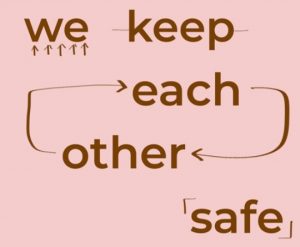
We keep each other safe – a guide for migrants in the UK


A negative shift in how migrants, including refugees and people seeking asylum, are viewed in the UK has been documented in research, including VISION work, and media. Rhetoric about migration has become more aggressive and emboldened racist demonstrations and attacks on asylum accommodation.

VISION partnered with Migrants’ Rights Network (MRN) to co-develop a research project with migrants that maps experiences of harm and identifies community-led safety strategies. The research centred on two cities, London and Belfast, working with communities who have experience of the asylum system / no recourse to public funds. Through a series of focus groups and workshops, migrants shared their experiences of far-right violence, and how they are already keeping themselves and each other safe. ​

The project brings together MRN’s narrative work, which actively challenges disinformation about migration, while trying to better understand and document the impact of hostile language on people currently in the immigration system.

The key findings and themes​ of the research are:

  • Impact on mental health and change in behaviours ​
  • Role of the state in making migrants unsafe, and low trust in institutions​
  • Everyone is experiencing it, but no one is talking about it​
  • We keep each other safe – what are we already doing, and what else can we do together

These insights coalesced into a free workbook available for downloading on the MRN website. The practical guide is for migrants in the UK co-developed with migrants and migrant-led organisations. It features shared knowledge, scenarios, and messages of solidarity.

To download the free resource: We keep each other safe workbook: Migrant community insights on building safety

For further information on the VISION – MRN collaboration, please see the blog, Understanding Violence: The risks for migrants with rising far-right fascism, written by Aya Khedairi, MRN Community Engagement Manager.

AI photo from Adobe Stock subscription

VISION responds to Parliamentary, government & non-government consultations

Consultation, evidence and inquiry submissions are an important part of our work at VISION. Responding to Parliamentary, government and non-government organisation consultations ensures that a wide range of opinions and voices are factored into the policy decision making process. As our interdisciplinary research addresses violence and how it cuts across health, crime and justice and the life course, we think it is important to take the time to answer any relevant call and to share our insight and findings to support improved policy and practice. We respond as VISION, the Violence & Society Centre, and sometimes in collaboration with others. Below are the links to our published responses and evidence from June 2022.

  1. UK Parliament – International Development Committee – Inquiry: Women, Peace and Security. Our submission was published in March 2026
  2. UK Parliament – Public Bill Committee – Call for evidence: Crime and Policing Bill. Our submission was published in 2025
  3. UK Parliament (Library) – POSTNote – Approved Work: Violence Against Women and Girls in schools and among children & young people. Two VISION reports were referenced in their POSTNote published in August 2025
  4. UK Parliament – Public Accounts Committee – Inquiry: Tackling Violence against Women and Girls (VAWG). Our submission was published in April 2025
  5. UK Parliament – House of Lords Select Committee on Social Mobility Policy – Call for Evidence: Exploring how education and work opportunities can be better integrated to improve social mobility across the UK. Our submission was published in 2025
  6. UK Parliament – Women and Equalities Committee – Inquiry: Community Cohesion. Our submission was published in February 2025
  7. UK Parliament – Call for evidence on the Terminally Ill Adults (End of Life) Bill. Our submission was published in February 2025
  8. UK Parliament – Public Accounts Committee – Inquiry: Use of Artificial Intelligence in Government. Our submission was published in January 2025
  9. UK Parliament – Public Accounts Committee – Inquiry: Tackling Homelessness. Our submission with Dr Natasha Chilman was published in January 2025. See the full report
  10. Home Office – Legislation consultation: Statutory Guidance for the Conduct of Domestic Homicide Reviews. Our submission was published on the VISION website in July 2024
  11. UK Parliament – Women and Equalities Committee – Inquiry: The rights of older people. Our submission was published in November 2023
  12. UK Parliament  – Women and Equalities Committee – Inquiry: The impact of the rising cost of living on women. Our submission was published in November 2023
  13. UK Parliament – Women and Equalities Committee – Inquiry: The escalation of violence against women and girls. Our submission published in September 2023
  14. Home Office – Legislation consultation: Machetes and other bladed articles: proposed legislation (submitted response 06/06/2023). Government response to consultation and summary of public responses was published in August 2023
  15. Welsh Government – Consultation: National action plan to prevent the abuse of older people. Summary of the responses published in April 2023
  16. Race Disparity Unit (RDU) – Consultation: Standards for Ethnicity Data (submitted response 30/08/2022). Following the consultation, a revised version of the data standards was published in April 2023
  17. UK Parliament – The Home Affairs Committee – Call for evidence: Human Trafficking. Our submission was published in March 2023
  18. UN expert – Call for evidence: Violence, abuse and neglect in older people. Our submission was published in February 2023
  19. UK Parliament – The Justice and Home Affairs Committee – Inquiry: Family migration. Our submission was published in September 2022 and a report was published following the inquiry in February 2023
  20. Home Office – Consultation: Controlling or Coercive behaviour Statutory Guidance. Our submission was published in June 2022

For further information, please contact us at VISION_Management_Team@city.ac.uk

Photo by JaRiRiyawat from Adobe Stock downloads (licensed)

VISION/VASC Webinar Series: IPV and the LGBTQI+ communities

This event is in the past.

We are pleased to announce the VISION and Violence & Society Centre (VASC) Webinar Series.

The purpose of the series is to provide a platform for academia, government and the voluntary and community sector that work to reduce and prevent violence to present their work / research to a wider audience. This is a multidisciplinary platform and we welcome speakers from across a variety of fields such as health, crime, policing, ethnicity, migration, sociology, social work, primary care, front line services, etc.

Our first webinar is Tuesday, 20 February 2024, 1300 – 1350. We welcome Dr Steven Maxwell, Research Associate in the School of Social & Environmental Sustainability and Associate in the School of Health and Wellbeing, at the University of Glasgow.

Steven will present his research on intimate partner violence within the LGBTQI+ communities. He is a former mental health nurse and completed his PhD in Global Public Health at University College London in 2021. Steven’s PhD explored HIV pre-exposure prophylaxis uptake/adherence among men who have sex with men who engaged in sexualised drug use. His current interest is researching health inequities/social justices across minority and deprived populations, particularly sexual & mental health, and related substance use.   

To register for the event in order to receive the Teams invitation and / or if interested in presenting at a future Series, please contact: VISION_Management_Team@city.ac.uk

The VISION/VASC Webinar Series is sponsored by the UK Prevention and Research Partnership consortium, Violence, Health and Society (MR-V049879) and the Violence and Society Centre at City, University of London.

Webinar: Hate crime and human rights – Taiwan, UK and global perspectives

This event is in the past.

28 June 2023, 12:30 – 13:40 BST, online

The Violence & Society Centre at City and the UKPRP VISION Consortium are pleased to invite you to Hate Crimes and Human Rights: Taiwan, UK and Global Perspectives.

Po-Han Lee and Wen Liu are members of TUSHRN, an ESRC funded network of sex, gender and sexuality health (SGS) researchers in Taiwan and the UK, which includes City, LSHTM, and Lancaster. They will be visiting the Centre on 28 June to present their research:

  • Queer Politics in South/East Asia: State-Sponsored Hate and Political Cultural Relativism (by Po-Han Lee)
  • Anti-Asian Violence Amidst US-China Geopolitical Conflicts: The Limits of “Hate” Discourses and Cross-Racial and Cross-National Solidarity (by Wen Liu)

Please register by emailing your interest to VISION_Management_Team@city.ac.uk. An invitation with the Teams link will be emailed to you 28 June.

Please see below for the programme and the presenters’ biographies.

Programme

12:30-12:35 Introductions

12:35-1:00 Queer Politics in South/East Asia: State-Sponsored Hate and Political Cultural Relativism (by Po-Han Lee)

1:00-1:25 Anti-Asian Violence Amidst US-China Geopolitical Conflicts: The Limits of “Hate” Discourses and Cross-Racial and Cross-National Solidarity (by Wen Liu)

1:25-1:40 Overall Q&A and reflections

Biographies

Po-Han (Peter) Lee:

Po-Han Lee is an Assistant Professor at the Global Health Program and the Institute of Health Policy and Management at National Taiwan University. Previously trained in International Law and Political Sociology, he has been studying the construction, circulation and consumption of the right to health discourse in global health policymaking. Po-Han has been a member of the Feminist Review Collective (UK) and a senior editor for Plain Law Movement, the first multimedia platform for legal and human rights education in Taiwan. He recently published the book, Towards Gender Equality in Law (2020), which he co-edited with Gizem Guney and David Davies, and his new book, Plural Feminisms: Navigating Resistance as Everyday Praxis, coedited with Sohini Chatterjee, is being published later in 2023.

Wen Liu:

Wen Liu is an Assistant Research Professor at the Institute of Ethnology, Academia Sinica, Taiwan. Trained as a critical social psychologist and informed by queer and critical race theory, her book project (forthcoming from the University of Illinois Press) investigates diasporic Asian American subjectivities and their geopolitical alignments in times of US-China interimperial rivalry.

Photo by Markus Spiske on Unsplash