5th VISION annual conference: Presentations and illustrations now available
The fifth VISION annual conference was held on 7 July at The Light Auditorium in Friends House. The theme was Violence prevention in dialogue: Research and Policy.
After five years of research looking at violence prevention and the resulting health inequalities and focusing on improved measurement, policy, and practice, and delivering through a strong cross-sector partnership, we showcased our research in partnership with stakeholders Refuge, High Trees, Migrants’ Rights Network, Gloucestershire police constabulary, and Revolving Doors. In addition, we invited those working in violence prevention to critically assess our contributions and identify where further research and prioritised focus are required.
Jo Todd of Respect and Professor Gene Feder, VISION Director, reflected on 25 years of working in violence prevention as frontline practitioners and researchers. Drawing on their extensive experience, they highlighted both the progress made and the challenges that remain. While collaboration between government, academia, and the third sector has improved, longstanding silos—particularly across the health and criminal justice sectors—persist. Overcoming these barriers requires sustained commitment to relationship-building and cross-sector working.
They noted that significant progress has been made in violence prevention policy, including the publication of the government’s Violence Against Women and Girls (VAWG) strategy last year. However, there remains considerable interest in how the incoming Prime Minister will take forward the Labour government’s commitment to halve violence against women and girls within a decade, and what this will mean for future policy, practice, and investment.
Professor Liz Kelly from London Metropolitan University was our 2nd keynote speaker and shared her thoughts on the language and naming of violence in the 21st century. Liz highlighted that language changes not just what we say but what we know and recognise. The words we use in the field as researchers, analysts, policymakers, officials, and practitioners matter and should be clear and grounded in victim / survivor agency and freedom.
VISION research was highlighted in three symposiums:
- Insight: Key findings on definitions and measurement within violence prevention
- Dr Vishal Bhavsar (Kings College London) and Professor Miranda Horvath (University of Suffolk) presented on intimate partner violence perpetration.
- Dr Madeleine Janickyj (University College London) and Emma Pickering (Refuge) presented on technology facilitated abuse.
- Inclusion: Violence prevention research with marginalised populations
- Dr Alexandria Innes (City St George’s UoL), Aya Khedairi (Migrants’ Rights Network) and Professor Gargi Bhattacharyya (University College London) presented on insecure migration status. Andri and Aya discussed their project, Understanding Violence: the risks for migrants with rising far-right fascism and the resulting output, Workbook: Migrant Community Insights on Building Safety. Gargi highlighted how the far right is misusing genuine work and research and that media discussion of VAWG frequently descends into racism and incitement.
- Dr Annie Bunce (City St George’s UoL) and Lauren Bennett and Anthony Donohoe from Revolving Doors presented their work on developing principles for co-analysis with Lived Experience.
- Involve: A look at two ongoing, impactful pieces of VISION research with partners
- Dr Elizabeth Cook (City St George’s UoL) and Harry Jenkins (High Trees) presented their collaborative research developing Built on Trust, a report with youth from Lambeth in London on the role of youth spaces and trusted adults in reducing young people’s exposure to violence.
- Dr Ruth Weir (City St George’s UoL) and Sophie Jarrett (Gloucestershire Police) presented on their system-wide partnership with central and local government, police, education trusts, and the third sector to understand and prevent teenage relationship abuse (TRA). This work has resulted in the establishment of a national group on TRA and a local group wtihin Gloucestershire.
VISION co-Deputy Directors, Professor Sally McManus (City St George’s UoL) and Dr Estela Capelas Barbosa (University of Bristol) closed the conference by reflecting on the achievements of the VISION consortium and outlining priorities for the future of violence prevention research, policy, and practice. Sally highlighted the wide range of datasets, tools, resources, and publications developed by VISION over the past five years. Looking ahead, Estela emphasised the need for further research on violence affecting LGBTQI+ communities and minoritised women and children. She also stressed the importance of breaking down the persistent silos between the health and criminal justice sectors, noting that the impacts of violence extend across both systems. Effective prevention and support therefore require joined-up services, coordinated policies, and cross-sector collaboration.
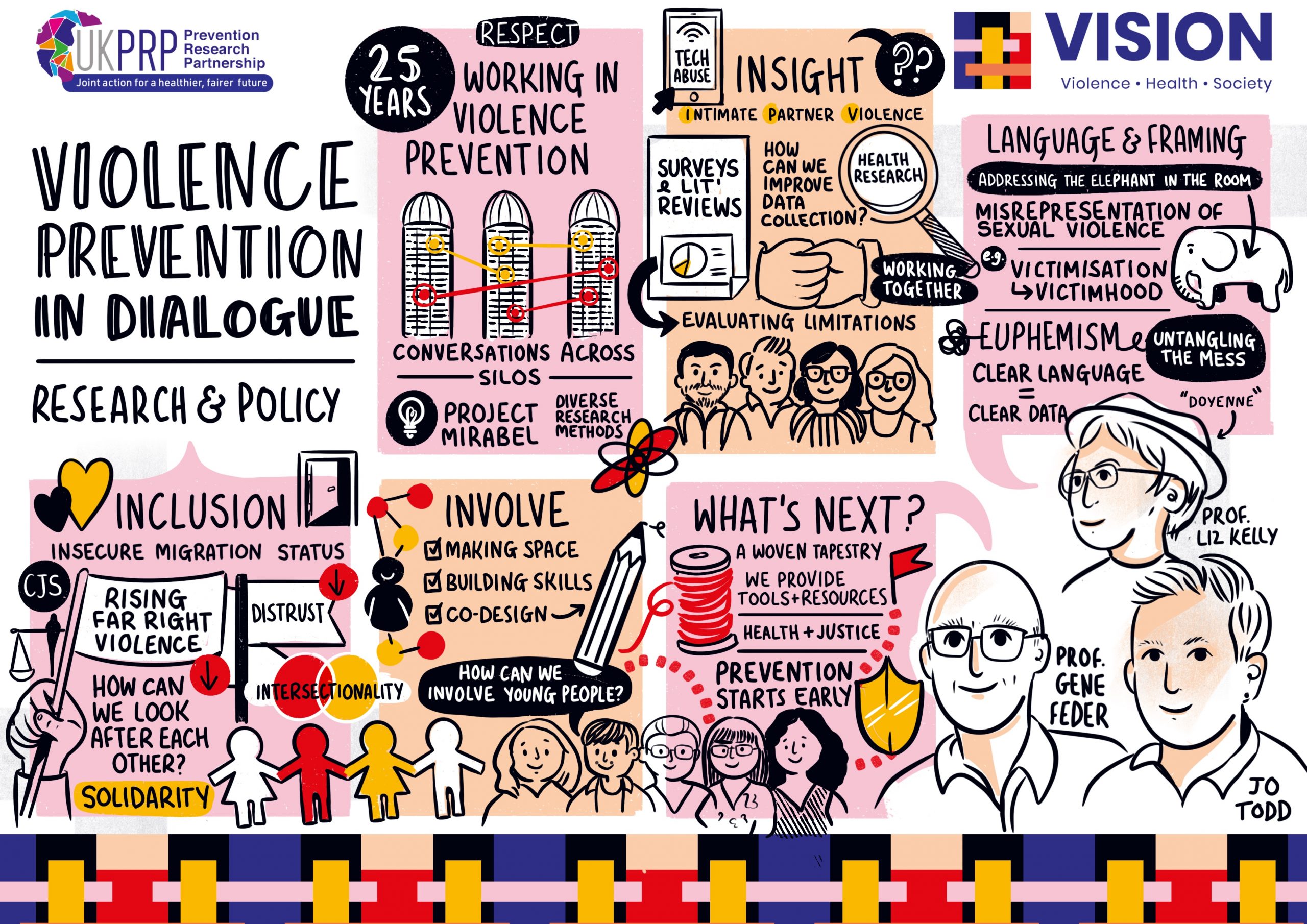
Visual artists, Abigail and Chloe Baldwin, from Buttercrumble, beautifully captured the day in a series of illustrations which can be downloaded below along with the keynote and symposium presentations.
To download the presentations:
- Insight Symposium: Insight Symposium_Perpetrators of IPV; Insight Symposium_Tech Abuse
- Inclusion Symposium: Inclusion Symposium_Insecure migration status; Inclusion Symposium_Co-design of analysis principles
- Involve Symposium: Involve Symposium_Partnering with young people; Involve Symposium_Teenage Relationship Abuse
- Professor Liz Kelly, 2nd Keynote: Keynote 2_The language and naming of violence
- Professor Sally McManus, VISION Achievements: VISION achievements
To download the illustrations: