Violence across the life course and physical and mental health trajectories in later life
Anastasia Fadeeva, VISION Research Fellow, City St George’s University of London
Symposiums
Lessons Learned from Lived Experience Engagement in Violence and Trauma Research
Sian Oram, Professor at Kings College London and VISION Co-Investigator
Kimberly Cullen, VISION Knowledge Exchange Manager, City St George’s UoL
Alicia Stillman, Violence, Abuse and Mental Health Network at Kings College London
Polina Obolenskaya, VISION Research Fellow, City St George’s UoL
Annie Bunce, VISION Research Fellow, City St George’s UoL
Policy insights from a population understanding of mental health inequalities: using England’s mental health survey series, the Adult Psychiatric Morbidity Surveys (APMS)
Presenters include:
Sally McManus, Professor at City St George’s UoL and VISION Co-Deputy Director
Elizabeth Cook, Senior Lecturer at City St George’s UoL and VISION Co-Investigator
Centring the voices of young people – Learning from four participatory, place-based approaches to violence prevention
Presenters include:
Elizabeth Cook, Senior Lecturer at City St George’s UoL and VISION Co-Investigator
Ruth Weir, VISION Senior Research Fellow at City St George’s UoL
Understudied Commercial Drivers of Health: Exploring Industry Practices & Developing a Prevention Research Agenda
Presenters include Sally McManus, Professor at City St George’s UoL and VISION Co-Deputy Director
Workshop
Using Systems Approaches to Connect Communities and Tackle Complexity in Prevention
Workshop leads include Olumide Adisa, VISION Co-Investigator at City St George’s UoL
The APMS is the longest running mental health survey series in the world and provides a picture of how mental health is changing across England. The national study includes people from across English society, not just those that currently use NHS services or have in the past. A random sample of approximately 7,000 adults aged 16 to 100 living in England were asked questions about their mental health, whether they used any of a range of illicit drugs, and if they had experienced signs of dependence, such as symptoms of withdrawal or increased tolerance.
Findings
Drug use may be more widespread
Non-medical use of prescription opioids may be more widespread
In the 16- to 24-year-old age group, the signs of drug dependence were similarly common in men and women which is a noticeable shift from past APMS findings
Cannabis dependence is rising
There appears to be a lack of specialist support as about one adult in every five who showed signs of drug dependence reported they’d ever received support or treatment for drug use
Despite decades of progress, the gender pay gap remains a persistent feature of the UK labour market. Currently women in the UK earn approximately 11% less than men.
VISION researcher and Reader at City St George’s UoL, Vanessa Gash, writes in her article, The gender pay gap looks different depending where you are on the income ladder, for The Conversation, that the gender pay gap is not just because of differences in education or job type, but due to deeper inequalities in how work and care responsibilities are distributed.
Based on a study investigating barriers to equal pay, Vanessa and colleagues examined different predictors of the gender pay gap at the mean and for different income groups. Using the United Kingdom Household Panel Survey (UKHLS), the team provided a detailed analysis of the effects of individual work histories, with up to 40 years of retrospective data to uncover how these inequalities play out across income groups.
Findings
Equal pay policies must be tailored to the needs of different income groups. For wealthier households, policies that support full-time work and chip away at sex segregation may be effective so that women can more readily access better-paid jobs. But for poorer households, the focus should be on improving access to stable and better-paid jobs, while reducing discrimination and supporting flexible work arrangements.
Efforts to close the gender pay gap must avoid pitting the gains of high-earning women against the losses of low-earning men. In an era of rising political populism, this could undermine support for equality.
Promotion of good-quality employment for all and supporting equalised caregiving responsibilities is necessary.
By failing to address the barriers that prevent men and women from participating fully in both paid work and unpaid care work, reductions in the gender pay gap are unlikely any time soon.
Blog by Dr Polina Obolenskaya, Merili Pullerits and Dr Niels Blom
The UK government is expected to publish its new Violence Against Women and Girls (VAWG) strategy later this year. The strategy is part of a broader ambitious commitment to halve VAWG within a decade. A new combined measure of domestic abuse, sexual assault, and stalking, developed by the Office for National Statistics (ONS), has been proposed to serve as the main benchmark for evaluating progress toward this commitment.
Here we outline three main concerns the VISION consortium has with the proposed approach.
Lack of historical continuity
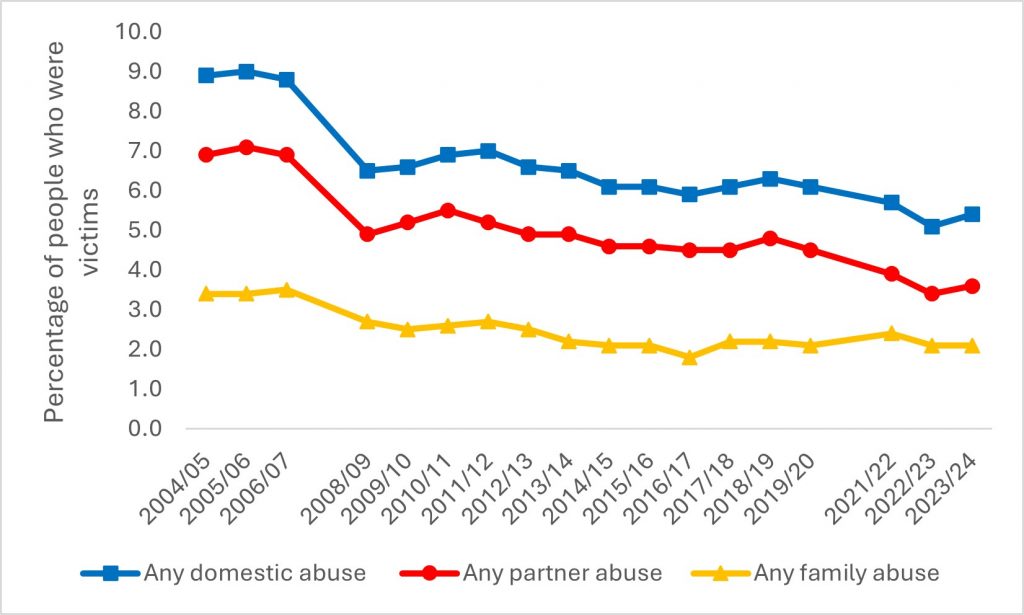
To assess the effectiveness of the VAWG strategy, historical continuity is crucial. Rates of domestic abuse in England and Wales have declined in recent years (Figure 1). Therefore, any assessment of a decline or rise in VAWG needs to be placed in the context of broader declining violence rates. Without this historical continuity, the government cannot distinguish between improvements driven by their strategy and those resulting from long-term social changes that were already underway.
Figure 1 Prevalence of domestic abuse in the last year among people aged 16 to 59 in England and Wales, 2004/05 to 2023/24
However, the new combined measure disrupts this continuity. This is due to changes to the question wording and structure of its composite measures. The new combined measure of VAWG consists of self-completion data from a newly developed Domestic Abuse module (piloted in 2022/23 and 2024/25, and fully implemented from 2025/26), as well as a combination of the old and new Sexual Victimisation module (piloted in 2025/26 and planned for full implementation from 2026/27).
The new Domestic Abuse module had undergone a complete redevelopment, with extensive negative repercussions for historical continuity, which we have outlined previously. While the sexual victimisation module is not being re-developed as considerably, the comparability of the new data to the previously collected data can only be assessed once the first round of results is available. This means a new stable and comparable measure will not be available in its final form until the 2026/27 data collection, despite the government’s strategy period beginning in 2025/26.
Without historical continuity, it will not be possible to produce long-term trends over time in the composite measure of VAWG for England and Wales for some years to come. Given the decline of some forms of violence in recent decades, it is important to examine whether any decline in VAWG is due to genuine policy success, or due to a continuation of pre-existing trends.
Incomplete scope of violence
While the government has indicated that it intends to supplement the new combined measure of domestic abuse, sexual victimisation and stalking with additional metrics, it is currently unclear what these supplementary measures will include or how they will be weighed against the main benchmark. In any case, the narrow scope of the new combined measure has been raised as a concern both among academics and others working in the sector.
Some of the limitations of the measure are due to the unavailability of certain measures in data it is based on – the Crime Survey for England and Wales. The End Violence Against Women coalition (EVAW) has highlighted that the new measure fails to reflect the full spectrum of violence experienced by women and girls, omitting online abuse, child abuse, ‘honour’-based abuse and sexual harassment (EVAW blog) as well as Female Genital Mutilation (EVAW briefing). These exclusions, as EVAW argues, risk distorting the true scale and impact of VAWG. Additionally, given alarming rates of teenage relationship abuse (e.g. Barter et al., 2009; Fox et al., 2013), we consider its exclusion to be a serious oversight in measuring VAWG – including girls – effectively. Since the combined measure excludes experiences of girls under the age of 16, its use as a main tool to measure government’s ambition to half ‘Violence against women and girls‘ may be misleading.
While the gaps outlined above stem from the limitations of the Crime Survey for England and Wales, we also have concerns about the scope of the measure which could be addressed with the data already available.
Firstly, the new combined measure excludes other offences which count within the CSEW as ‘violent crime’ or violence against a person. While men are more likely to be victims of such offences, disregarding women’s experiences of these risks undercounting their overall risks and impacts of violence (Cooper & Obolenskaya, 2021; Davies et al., 2025). For example, while a substantial amount of VAWG is covered by domestic abuse, sexual violence, and stalking, women also experience violence in other aspects of life, such as at work or in public spaces. Accounting for the above offences significantly increases the proportion of people experiencing violence and more accurately reflects the extent of violence experienced by women and girls.
Secondly, the new combined measure omits broader violence-related offences, for which data are available in the CSEW. This includes threats of violence and other criminal offences which are coded as ‘non-violent’ by the ONS (due to a methodological process involving priority ordering of offences), even though they involve the threat or use of force or violence (Davies et al., 2025; Pullerits & Phoenix, 2024). These offences should be included in any overall measure of VAWG regardless of who is most affected. However, their omission is especially problematic given that they disproportionately affect women (Davies et al., 2025; Pullerits & Phoenix, 2024), meaning the headline measure is likely to underestimate women’s experiences even further.
Although the government has suggested that other metrics are planned to be used, separately, to assess progress towards halving VAWG, having a narrow main measure risks reinforcing outdated gender norms where women are considered to be more affected by what happens at home rather than outside of it. Such a perspective fails to capture emerging forms of abuse and fails to reflect the full spectrum of women’s lived experiences with violence.
Collected new Domestic Abuse data had not undergone statistical validity and reliability checks and had not been subjected to wider scrutiny (as raised by VISION previously) before the decision to replace the old module with it was finalised.
Changes to the Domestic Abuse and Sexual Victimisation modules appear to have been made independently from each other, with limited coordination across the survey modules. Given the similarity in the phrasing of a few questions across the modules, this lack of foresight and integration appears to have resulted in overlapping content that could lead to confusion both for respondents and for those interpreting the data.
The development process has lacked transparency and consultation with external stakeholders, as raised by EVAW.
Recommendations for improvement
The ONS’s new combined measure of VAWG risks oversimplifying the complex realities of violence against women and girls. Even with supplementary metrics, relying on such a narrow primary benchmark – which lacks historical continuity and is limited in scope – will not adequately support evidence-based policy development or serve the needs of those most affected by violence and abuse.
To ensure more meaningful monitoring, we have three key recommendations to the ONS:
Prioritise historical continuity in Domestic Abuse data collection: We urge the ONS to revert to a Domestic Abuse module that aligns more closely with the previous version to ensure data continuity. While we welcome the inclusion of new questions on coercive control and family-related violence, we strongly believe these additions could be integrated into the long-standing existing framework without disrupting the historical comparability of the data. If a full reversion is not feasible, we recommend that theONS takes steps to ensure meaningful assessment of change and continuity using the new measure. These steps should involve: publishing clear comparability assessments between old and new measures; providing bridging data where methodologically possible; and maintaining transparency about limitations.
Broaden the scope of the ‘combined’ measure and make it explicit that it does not fully reflect the experience of girls: the definition of violence against women and girls should be expanded by using existing CSEW data to include “violence against the person” offences, as well as, possibly, other incidents where violence or threat of violence took place but that are not coded as “violent crime” by ONS. The CSEW currently provides insufficient coverage of technology-facilitated and online abuse, which should be a development priority going forward, given the increasing prevalence of these forms of violence both within domestic contexts but also outside of them. Additionally, since the combined measure does not capture violence experienced by girls under the age of 16, the government needs to make it clear that the headline measure, should it be used in the strategy, reflects only experiences of (young) women, not girls.
Enhance transparency and accountability in survey development: we call on the ONS to address technical and transparency concerns regarding their measures and commit to greater openness in their approach. Any new module should be subject to timely, transparent analysis and external scrutiny of it before it becomes a permanent change in the survey.
If the government is genuinely committed to halving violence against women and girls within a decade, it must first ensure its measurement approach is comprehensive, meaningful and methodologically sound. Relying overwhelmingly on a narrow headline measure risks presenting an incomplete picture of the problem of VAWG, and risks undermining both accountability and progress.
Cooper, K. & Obolenskaya, P. (2021). Hidden Victims: The Gendered Data Gap of Violent Crime, TheBritish Journal of Criminology, 61(4): 905–925. https://doi.org/10.1093/bjc/azaa100
Davies, E., Obolenskaya, P., Francis, B., Blom, B., Phoenix, J., Pullerits, M. & Walby, S. (2025). Definition and Measurement of Violence in the Crime Survey for England and Wales: Implications for the Amount and Gendering of Violence, The British Journal of Criminology, 65(2): 261–281. https://doi.org/10.1093/bjc/azae050
Fox, C. L., Corr, M. L., Gadd, D., & Butler, I. (2013). Young teenagers’ experiences of domestic abuse, Journal of Youth Studies, 17(4), 510–526. https://doi.org/10.1080/13676261.2013.780125
Pullerits, M. & Phoenix, J. (2024). How Priority Ordering of Offence Codes Undercounts Gendered Violence: An Analysis of the Crime Survey for England and Wales, The British Journal of Criminology, 64(2): 381–399. https://doi.org/10.1093/bjc/azad047
Frontiers in Sociology is currently welcoming submissions of original research for the following research topic: Enhancing Data CollectionandIntegration to Reduce Health Harms and Inequalities Linked to Violence.
This edition is guest-edited by Dr Estela Capelas Barbosa (University of Bristol and the UKPRP VISION research consortium), Dr Annie Bunce (City St. George’s, UoL and the UKPRP VISION research consortium), and Katie Smith (City St. George’s, UoL / University of Bristol).
Submissions should focus on any of the following:
advancing measurement approaches which emphasise cross-sector harmonisation to better evaluate interventions, address health inequalities, and reduce violence
addressing any form of violence (e.g., physical, non-physical, technology-facilitated) and its impacts on health, social and economic well-being, and marginalised groups, considering intersections of age, gender, ethnicity, disability, and religion
Research using existing datasets or primary data (quantitative or qualitative), cross-sectoral and cross-disciplinary approaches (e.g., sociology, criminology, public health), and lived experience perspectives is encouraged.
Contributions may include conceptual reviews, methodological innovations, empirical studies and systematic reviews on themes such as health inequalities, intervention effectiveness, outcome measurement, data harmonisation, and linkage strategies.
Abstracts are due by 7th April 2025, and the deadline for manuscripts is 28th July 2025.
This special edition provides an excellent opportunity to advance knowledge in this critical area. Please do reach out and contact us if you have any questions: annie.bunce@city.ac.uk
The Office for National Statistics (ONS) is making a major decision this month on the future of Crime Survey for England and Wales (CSEW) Domestic abuse measurement and monitoring.
Last year, ONS ran an experiment where half of the CSEW sample got the domestic abuse module used since 2005, and the other half got a new module that is not comparable with the previous one. ONS intend to move over entirely to the new module in the next data collection (2025/26).
Loss of the existing module has major implications: it is world-leading, uses globally comparable items, and with trend data going back to 2005. Without consistently administered core items from that module, it will no longer be possible to:
Produce long-term trends over time in domestic abuse for England and Wales.
Group a decade of survey years together to have enough cases to robustly examine domestic abuse in particular regions, minoritised groups, and by other protected characteristics for many years. This is essential for understanding inequalities in violence and subsequent service contact, and whether these are changing.
The new module is problematic for many reasons:
Is not a standardised measure, has undergone little validation or psychometric testing, and is not comparable with anything used previously or in any other country or study.
It separates data collection between former and current partner based on relationship status at the time of the interview, not at the time of abuse. This distinction creates confusion for interpretation of analysis and may be misinterpreted. The distinction is also problematic for classification of casual and other relationship types.
The overhaul of the module was intended to align measurement with the Domestic Abuse Act 2021 definition, but it appears that domestic abuse as recognised by that Act cannot be identified by this module.
We urgently recommend that before losing this world-leading time series and relying on an untested, not comparable, and flawed new approach to DA measurement in England and Wales, that ONS:
Pause: continue the split-sample data collection for one more year.
Test the new approach: fully compare data collected using the new and old modules data so the validity and utility of the new measures can be evaluated appropriately, and its impact on inequalities assessed.
Publish these results publicly: and fully consult once stakeholders understand all the implications of having data collected in each way before the decision to roll out new data collection is finalised.
With this information, then compare all options: such as maintaining some of the existing questions alongside adding new coercive control items. This straightforward approach would ensure the utility of the survey for national trends (in both England and Wales) and analysis of inequalities and minoritised groups, while also improving the measurement of coercive control.
Note that ONS is planning a raft of further changes with similar implications for trends and analysis of minoritised groups, including:
Removal of the sexual victimisation module from next data collection (2025/26), with redevelopment at some future date.
Removal and redevelopment of the nature of partner abuse questions, which cover DA survivors service use and police contact and are essential to understanding whether some groups are underserved by services.
These will further undermine continuity of data for trends and the ability to analyse minoritised groups or by protected characteristics.
This VISION Policy Brief highlights emerging findings and policy recommendations from ongoing research and stakeholder engagement into abuse in teenage relationships carried out by the UKPRP VISION consortium.
Abuse—whether physical, emotional, or sexual—within young people’s relationships is often overlooked in both research and policy. The Crime Survey for England and Wales (CSEW) finds that young women aged 16 to 19 are more likely to experience domestic abuse than any other age group. Despite this high prevalence, this age group is less likely to be referred to support services. Furthermore, the CSEW does not cover individuals under the age of 16, leaving a major gap in understanding of prevalence.
Key findings:
Lack of consistent terminology and recognition – various terms are used to describe abuse in teenage relationships, including ‘teen dating violence’, ‘adolescent domestic abuse’, ‘teenage relationship abuse’ and ‘youth intimate partner violence’. Both the workshop with young people and the roundtables identified that young people generally do not associate the behaviours they experience with any of these terms and are more likely to use language like ‘toxic relationships’.
Very limited UK research on risk and protective factors for under 16s – our rapid review found that in the last 10 years there was only one UK academic study that looked into risk and protective factors for abuse in teenage relationships for those aged under 16.
Importance of schools and communities – unlike adult domestic abuse, which is largely experienced in private, abuse experienced in teenage relationships is more likely to occur outside of the home, especially within schools.
Very difficult to measure extent of issue – due to the current Home Office definition of domestic abuse there is very limited and consistently recorded administrative data collected on those under 16 who are experiencing abuse.
Need to take a more radical review of systems – our discussion highlighted the difficulty of addressing abuse in teenage relationships within the current systems.
Recommendations for change:
Develop a national strategy – prevention and early intervention
Explore support for young people – victims and those carrying out harmful behaviours
Commission research into under 16s – including those with lived experience and taking a whole systems approach
Improve measurement in under 16s
Agree terminology and produce an associated education programme
To cite: Weir, Ruth; Barrow-Grint, Katy (2025). VISION Policy Brief: Addressing Abuse in Teenage Relationships. City, University of London. Report. https://doi.org/10.25383/city.26539906.v1
This VISION Policy Brief proposes improvements to the definitions and measurement of violence using the Crime Survey for England and Wales (CSEW), in order to more fully capture different aspects of violent crime, including violence against women and girls (VAWG). The briefing is aimed at researchers, national statistics offices, and others involved in violence research and policy. It draws on a paper recently published in The British Journal of Criminology, Definition and measurement of violence in the Crime Survey for England and Wales.
Key findings:
The current definition of violent crime excludes key types: The Office for National Statistics (ONS) headline measure of ‘violent crime’ currently excludes sexual violence, robberies, threats of violence, and many incidents of violence where criminal damage was also involved.
A broader definition would better capture scale, harm and inequalities: We use a broader measure of violence that includes these currently excluded forms of violence. This broader measure not only reveals a higher prevalence of victimisation in the population as a whole, it also reveals hidden inequalities. Women are more likely than men to experience sexual violence and threats of violence: excluding these from current estimates leads to rates of violence in women, especially domestic violence, being underestimated. The proportion of people physically and emotionally harmed by violence is also better estimated using this broader definition, particularly affecting estimates for women.
Recommendation for change:
National statistics on violence in England and Wales should show violence estimates using a broader definition of violence alongside violent crime statistics to give a more comprehensive overview of violence and its societal impact.
The citation for the paper: Davies, E., Obolenskaya, P., Francis, B., Blom, N., Phoenix, J., Pullerits, M., and Walby, S. (2024), Definition and Measurement of Violence in the Crime Survey for England and Wales: Implications for the Amount and Gendering of Violence, TheBritish Journal of Criminology. https://doi.org/10.1093/bjc/azae050
The definitions and methodology used in surveys to measure violence have implications for its estimated volume and gendered distribution. The Crime Survey for England and Wales (CSEW) uses quite a narrow definition of ‘violence against the person’ which excludes crimes which are arguably violent in nature.
VISION researchers Elouise Davies, Polina Obolenskaya, Brian Francis and Niels Blom worked with colleagues Jessica Phoenix, Merili Pullerits and Sylvia Walby to expand the CSEW’s measurement of violence to include threats, robbery, sexual violence and mixed violence/property crimes as violence.
The team investigates the implications of using an expanded definition of violence on the subsequent estimates of interpersonal violence and its distribution (the proportion of incidents of violence committed towards women, and the proportion of incidents that are committed by domestic relations rather than acquaintances or strangers). Additionally, they investigate how the expanded definition of violence shows an increased health burden of violence by investigating the number of injuries and the number and proportion of victims that are strongly emotionally impacted.
This results in a shift in the gender distribution of violence, with a higher proportion of violence against women (from 39% to 58%) and by domestic perpetrators (from 29% to 32%).
Impacts of violence – injuries and emotional harm – are also affected by the change in definition and disproportionally so for women.
Violence against older people is often overlooked. As a society, we often associate violence with young people, gangs, unsafe streets, and ‘knife crime’. However, violence also takes place behind front doors, perpetuated by families and partners, and victims include older people.
Some older people may be particularly vulnerable due to poorer physical health, disability, dependence on others, and financial challenges after retirement. Policy rarely addresses the safety of this population, with even health and social care professionals sometimes assuming that violence does not affect older people. For example, doctors may dismiss injuries or depression as inevitable problems related to old age and miss opportunities to identify victims (1). In addition, older people may be less likely to report violence and abuse because they themselves may not recognise it, do not want to accuse family members, or out of fear (2).
Given victims of violence often remain invisible to health and social services, police, or charities, the most reliable statistics on violence often come from national surveys such as the Crime Survey for England and Wales (CSEW) conducted by the Office for National Statistics. However, for a long time the CSEW self-completion – the part of the interview with the most detail on violence and abuse – excluded those aged 60 or more, and only recently extended to include those over 74. Some national surveys specifically focus on older people, but these ask very little about violence and abuse. Additionally, despite people in care homes or other institutional settings experiencing a higher risk of violence, it can be challenging to collect information from them. Therefore, many surveys only interview people in private households, which excludes many higher-risk groups.
We need a better grasp of the extent and nature of violence and abuse in older populations. First, reliable figures can improve the allocation of resources and services targeted at the protection of older people. Second, better statistics can identify the risk factors for experiencing violence in later life and the most vulnerable groups.
In the VISION consortium, we used the Adult Psychiatric Morbidity Survey (APMS 2014) to examine violence in people aged 60 and over in England (3). While we found that older people of minoritised ethnic backgrounds are at higher risk of violence (prevalence of 6.0% versus 1.7% in white people in 12 months prior to the survey), more research needs to be done to distinguish the experiences of different ethnic groups. Our research also showed that loneliness and social isolation were strongly related to violence in later life. Older people may experience social isolation due to limiting health issues or economic situations, and perpetrators can exploit this (4). Moreover, isolation of victims is a tool commonly used by perpetrators, especially in cases of domestic abuse (5). Knowing about these and other risk factors can help us better spot and protect potential victims.
Additionally, more needs to be learnt about the consequences of life course exposure to violence for health and well-being in later life. This is still a relatively unexplored area due to limited data and a lack of reporting from older victims and survivors. It is sometimes more difficult to establish the link between violence and health problems because the health impacts are not always immediate but can accumulate or emerge in later life (6). Also, as people develop more illnesses as they age, it is more challenging to distinguish health issues attributable to violence. Therefore we are also using the English Longitudinal Study of Ageing (ELSA) to examine temporal relationships between lifetime violence exposure and health in older age.
Dr Sophie Carlisle, Evaluation Researcher at Health Innovation East Midlands, and former VISION researcher, also reflects on violence against older people and includes an analysis of our study’s strengths and weaknesses in her 10 December 2024 blog on the Mental Elf website, Violence against older people – linked to poor mental health #16DaysOfActivism2024. Sophie highlighted how the study reported that violence against older people is often perpetrated by an intimate partner and is strongly associated with poor mental health.
In an inclusive society, every member should be able to lead a life where they feel safe and respected. We are delighted that the CSEW has removed the upper age limit to data collection on domestic abuse, which is one step towards making older victims and survivors heard. Continuous work on uncovering the ‘hidden’ statistics and examining the effects of intersectional characteristics on violence is crucial in making our society more inclusive, equal, and safe for everyone. For example, one VISION study (7) has demonstrated that the risks of repeated victimisation in domestic relationships had opposite trends for men and women as they aged. We are committed to support the Hourglass Manifesto to end the abuse of older people (8), and are willing to provide decision makers with evidence to enable a safer ageing society.
1. SafeLives U. Safe later lives: Older people and domestic abuse, spotlights report. 2016.
2. Age UK. No Age Limit: the blind spot of older victims and survivors in the Domestic Abuse Bill. 2020.
3. Fadeeva A, Hashemi L, Cooper C, Stewart R, McManus S. Violence against older people and mental health: a probability sample survey of the general population. forthcoming.
4. Tung EL, Hawkley LC, Cagney KA, Peek ME. Social isolation, loneliness, and violence exposure in urban adults. Health Affairs. 2019;38(10):1670-8.
5. Stark E. Coercive control. Violence against women: Current theory and practice in domestic abuse, sexual violence and exploitation. 2013:17-33.
6. Knight L, Hester M. Domestic violence and mental health in older adults. International review of psychiatry. 2016;28(5):464-74.
7. Weir R. Differentiating risk: The association between relationship type and risk of repeat victimization of domestic abuse. Policing: A Journal of Policy and Practice. 2024;18:paae024.
8. Hourglass. Manifesto A Safer Ageing Society by 2050. 2024.
Photo from licensed Adobe Stock library
Stay connected
Sign up with the VISION Consortium to learn more about our work and find out the latest news and events via our quarterly electronic newsletter.