Archives

Empowering voices against ‘honour’-based abuse: A call to action

This event is in the past.

There is an urgent need for specialist support for Middle Eastern, North African (MENA) and Afghan women and girls living in the UK, with many facing the particular risk of ‘honour’-based abuse (HBA).  On 18 October, the women’s rights organisation IKWRO held the impactful “Celebrating Courage: Empowering Voices Against Honour-Based Abuse” conference. It was hosted at City St George’s and proudly supported by the Violence and Society Centre (VASC) and VISION consortium.

The powerful event featured art, presentations, panels, film, and spoken word performances that shed light on the often-overlooked experiences of ‘honour’-based abuse (HBA) and the urgent need for education and prevention.

HBA disproportionately affects women and girls, it frequently goes unrecognised and is often conflated with domestic violence. Through this event, IKWRO, VASC and VISION aimed to illuminate the unique aspects of HBA and foster a deeper understanding of its implications.

A diverse group of speakers, including survivors, advocates, lawyers, and researchers, shared their insights and experiences. This included powerful testimonies from victims/survivors, bravely recounting their experiences of HBA. Their voices resonated throughout the room, creating a sense of solidarity and support, while also providing a safe space for discussion.

Over 100 people attended. A conference highlight was the strong presence of representatives from police and central government. Their attendance demonstrated a commitment to addressing HBA and offered them and other attendees a unique opportunity to engage directly with key figures at the forefront of the fight against HBA.

One salient moment during the conference occurred when VISION researcher Dr Ladan Hashemi, during the discussion with the police officers regarding enhancements to law enforcement responses, emphasised that “violence constitutes violence, and abuse constitutes abuse, regardless of an individual’s identity or background. It is essential for law enforcement agencies to acknowledge their obligation to prevent and mitigate HBA in the United Kingdom”.

The event also featured innovative approaches to communicating the issue of violence through art and spoken word. These forms of expression not only captivated the audience but also fostered a deeper understanding of the complexities surrounding HBA. By bringing art into a conference setting, IKWRO, VASC and VISION wanted to highlight the positive impact of creative communication, showcasing the experiences of survivors and the urgent need for change.

In honour of the International Day of the Girl Child, this event was an important step toward raising awareness about HBA and the specific challenges faced by women and girls in the UK to police, government, specialist services, academic researchers and the general public.  A world free of abuse and violence requires the prevention of HBA, and for IKWRO that starts in their home base of London.

Key to the event was the organisation and support of VISION’s Knowledge Exchange Manager, Kimberly Cullen, and Dr Hashemi. IKWRO, VISION, and VACS will continue to work collaboratively to elevate the voices of survivors and advocate for meaningful change in the fight against ‘honour’-based abuse.

Photo caption: IKWRO and VISION. Photograph supplied by IKWRO.

How much violence is there?

This VISION Policy Brief proposes improvements to the definitions and measurement of violence using the Crime Survey for England and Wales (CSEW), in order to more fully capture different aspects of violent crime, including violence against women and girls (VAWG). The briefing is aimed at researchers, national statistics offices, and others involved in violence research and policy. It draws on a paper recently published in The British Journal of Criminology, Definition and measurement of violence in the Crime Survey for England and Wales.

Key findings:

  • The current definition of violent crime excludes key types: The Office for National Statistics (ONS) headline measure of ‘violent crime’ currently excludes sexual violence, robberies, threats of violence, and many incidents of violence where criminal damage was also involved.
  • A broader definition would better capture scale, harm and inequalities: We use a broader measure of violence that includes these currently excluded forms of violence. This broader measure not only reveals a higher prevalence of victimisation in the population as a whole, it also reveals hidden inequalities. Women are more likely than men to experience sexual violence and threats of violence: excluding these from current estimates leads to rates of violence in women, especially domestic violence, being underestimated. The proportion of people physically and emotionally harmed by violence is also better estimated using this broader definition, particularly affecting estimates for women.

Recommendation for change:

  • National statistics on violence in England and Wales should show violence estimates using a broader definition of violence alongside violent crime statistics to give a more comprehensive overview of violence and its societal impact.

To download the policy briefing, please see below. To download the paper upon which the policy recommendation is based, please see: Definition and Measurement of Violence in the Crime Survey for England and Wales: Implications for the Amount and Gendering of Violence | The British Journal of Criminology | Oxford Academic

The citation for the paper: Davies, E., Obolenskaya, P., Francis, B., Blom, N., Phoenix, J., Pullerits, M., and Walby, S. (2024), Definition and Measurement of Violence in the Crime Survey for England and Wales: Implications for the Amount and Gendering of Violence, The British Journal of Criminology. https://doi.org/10.1093/bjc/azae050

VISION Policy Briefing for downloading:

Celebrating courage: Empowering voices against honour-based abuse

This event is in the past. For further information on ‘honour’-based abuse and how the event went, please see our blog, Empowering voices against ‘honour’-based abuse: A call to action – City Vision.

Join IKWRO and the UKPRP VISION consortium for an enlightening and impactful event dedicated to raising awareness and understanding of ‘honour’-based abuse.

We are proud to partner with women’s rights organisation, IKWRO, and host their upcoming event, Celebrating courage: Empowering voices against honour-based abuse, Friday 18 October 2024 at City, UoL.

IKWRO works to safeguard and empower women and girls against ‘honour-based’ abuse across the UK. Their mission is to advance Middle Eastern, North African, and Afghan women’s and girls’ rights, tackle discrimination and violence against women and girls, and empower women and girls to access their rights and entitlements in the UK. 

In honour of the International Day of the Girl Child, this in-person event is dedicated to raising awareness and understanding of “honour”-based abuse, which is predominantly suffered by women and girls.

Professionals, students, survivors, and anyone interested in understanding and combating honour-based abuse are welcome. This is an opportunity to learn from experts, connect with others in the field, and contribute to a meaningful dialogue on this important issue.

Event Highlights

  • Panel Discussions with a Q&A Session: An open forum for attendees to engage with our speakers and ask questions about honour-based abuse and how to tackle it effectively.
  • Experts in the field will discuss the nuances of honour-based abuse, its identification, and the challenges in differentiating it from domestic violence.
  • Survivors and advocates will share their personal stories and discuss support systems and empowerment strategies.

Event Details

Unleashing social media potential to research violence against women and girls in Iran

Researching violence against women and girls (VAWG) in low- and middle-income countries (LMICs) presents unique challenges, primarily due to various contextual factors that hinder conventional survey methodologies. These challenges include limited funding, political obstacles, and safety concerns for both researchers and participants. Consequently, traditional survey approaches may prove unfeasible or inadequate in capturing the complex realities of VAWG in these settings.

VAWG is a particularly pressing issue in Iran, a Middle Eastern country marked by its patriarchal structure and systematic and pervasive gender discrimination. The patriarchal and legal structure of the country perpetuates gender inequalities and reinforces societal norms that tolerate or even condone violence against women. Yet, understanding the full scope of VAWG in Iran remains hindered by a lack of robust data.

In a recently published study, VISION researchers, Ladan Hashemi and Sally McManus, collaborated with counterparts from Bristol University (Nadia Aghtaie) and Iran (Fateme Babakhani) to explore the effectiveness of social media in recruiting victims of violence in Iran, shedding light on their experiences and the potential of social media as a research tool.

The findings revealed valuable insights into the manifestation and context of VAWG in Iran. Social media recruitment proved to be effective in reaching a diverse sample of victims and provided crucial insights into the dynamics of violence, the identities of perpetrators, and the settings where violence occurs. Victims often reported experiences from more than one type of perpetrator, spanning both public and domestic spheres. While social media recruitment offers broad reach and a safer environment for data collection, it also presents challenges such as sampling biases which affect the generalisability of findings.

For further information please see: Social Sciences | Free Full-Text | Using Social Media to Recruit Seldom-Heard Groups: Reaching Women and Girls with Experience of Violence in Iran (mdpi.com)

Or contact Ladan at ladan.hashemi@city.ac.uk  

Photo from licensed Adobe Stock library

Consultation: Is there a need for a VAWG data dashboard?

This consultation has closed.

In 2022, the UK Office for National Statistics (ONS) developed a prototype violence against women and girls (VAWG) dashboard. The tool presents statistics and charts on violence against women and girls in England and Wales, drawing on multiple sources. However, due to re-prioritisation at ONS, maintenance of the dashboard was halted and from 1st April 2024 it will no longer be accessible.

The VISION consortium is consulting on whether there is need for a VAWG data dashboard. This consultation is seeking views on:

  •  Whether the dashboard was useful
  •  Who used it and why
  •  If the dashboard was to continue, what aspects should be kept, dropped or added.

The Qualtrics consultation link is now closed because the consultation is over.

Anyone interested in the idea of a VAWG data dashboard is welcome to respond to the survey, particularly if interested in using one in the future.

Answer as many questions as you like. You can provide contact details or complete this anonymously. The findings will be used to draft a report and provide recommendations on whether the dashboard should continue. The report will include a list of the groups and organisations that participated (where details are provided). Individuals will not be named, although quotes may be taken from the text provided. The report may be published, for example on the VISION website.

The ONS VAWG dashboard was available online until 31 March 2024. Therefore, if you would like to participate in this consultation, please view the sample screenshots of the tool below.

This consultation closed Monday 22 April.

For further information, please contact us at VISION_Management_Team@city.ac.uk

Working with specialist services’ administrative data

VISION researchers Dr Annie Bunce and Dr Estela Capelas Barbosa have been working with administrative data provided by specialist domestic and sexual violence and abuse (DSVA) support services.

Whilst the wealth and breadth of the data collected creates exciting opportunities for improving our understanding of patterns in experiences of violence and service use, the process of preparing the data for analysis has its challenges. Such challenges- and potential strategies for overcoming them- are not well documented, creating missed opportunities for improving the utilisation of specialist services’ data.

In their new publication, Annie and Estela, along with City, University of London PhD student, Katie Smith, and Dr Sophie Carlisle, a former VISION researcher, reviewed the scope and merits of administrative data generally, and that collected by specialist DSVA services specifically, and the evidence to date for its use by researchers.

They found that the extent to which new insights on violence from specialist services’ data can be used to inform policy and practice is limited by three interrelated challenges: different approaches to the measurement of violence and abuse; the issue of disproportionate funding and capacity of services, and the practicalities of multi-agency working.

Nonetheless, the authors maintain the unique contribution to knowledge on violence that can be provided by DSVA services’ administrative data, and are hopeful that the paper will encourage further discussion about how to better utilise it. Additional resources, collaboration between multiple agencies, service providers and researchers, and the integration of specialist services’ data with other sources of data on violence are needed to maximise policy impact. Given the benefits individuals and society stand to gain, this is a worthwhile endeavour.

For further information please see: Challenges of using specialist domestic and sexual violence and abuse service data to inform policy and practice on violence reduction in the UK in: Journal of Gender-Based Violence – Ahead of print (bristoluniversitypressdigital.com)

Or contact Dr Annie Bunce at annie.bunce@city.ac.uk

Photo from licensed Adobe Stock library

Event: Zero tolerance to female genital mutilation

This event is in the past.

The International Day of Zero Tolerance for Female Genital Mutilation (FGM) is 6 February every year. The United Nations Assembly designated the day with the aim to amplify and direct the efforts on the elimination of this practice.

In support to highlight the day and the horrific practice of FGM, IKWRO, a London-based human rights organisation for Middle Eastern, North African and Afghan women and girls living in the UK, is hosting Zero tolerance to female genital mutilation on 5 February 2024, 2 – 5 pm, in London at Resource for London, 356 Holloway Road, London N7 6PA.

The event brings together experts and survivors to shed light on the challenges and gaps in safeguarding women and girls globally in the context of FGM:

  • Payzee Mahmod, Campaign Manager at IKWRO
  • Naana Otoo-Oyortey, Executive Director of FORWARD, an African diaspora women’s rights organisation in the UK
  • Mama Sylla, an FGM survivor and chairwoman of La FRATERNITE UK, a London-based registered charity
  • Shamsa Araweelo, an FGM survivor and social activist
  • Janet Fyle, Royal College of Midwives’ (RCM) Professional Policy Advisor and a Cardiff University School of Policy Law accredited Expert Witness
  • Jaswant Kaur Narwal, Chief Crown Prosecutor
  • Aisha K. Gill, Ph.D., CBE is Professor of Criminology at University of Bristol
  • Detective Superintendent Alex Castle, Metropolitan Police and Lead Responsible Officer for Harmful Practices and co-chair of the London Harmful Practice Working Group

Speakers and attendees will engage in discussions about the pressing issues surrounding FGM such as the challenges and barriers to disclosure, reporting and prosecution and explore ways to bridge the existing gaps through policy changes, community involvement and institutional improvements.

For further information on the free event and to register, please see: Zero Tolerance to FGM Conference

Or please contact VISION Senior Research Fellow, Dr Ladan Hashemi at: ladan.hashemi@city.ac.uk

Photo by Joel Muniz on Unsplash

VISION Adolescent Domestic Abuse conference

This event is in the past.

If registered, please enter through the main entrance in the University Building, across from Northampton Square, a green space with a gazebo. There is also a silver sculpture in front of University Building.

Only those that registered will be able to enter the conference room.

To register please see: VISION and VASC Adolescent Domestic Abuse conference

The UK Prevention Research Partnership Violence, Health & Society (VISION) consortium and the Violence and Society Centre at City, University of London, are pleased to announce the Adolescent Domestic Abuse conference.

Thursday 18th April 2024, 10:00 – 17:00 followed by a reception 
Oliver Thompson Lecture Theatre (Tait Bldg), City, University of London, EC1B 0HB 

Adolescent domestic abuse, which includes physical, emotional, and/or sexual abuse that occurs between young people who are, or were, dating, is often overlooked in research, policy and practice. The current definition of domestic abuse leaves those aged under 16 in teenage relationships falling into the gap between child protection procedures and adult-focused domestic abuse policy. 

The conference brings together academics, practitioners, and policy makers to share existing research, policy and practice.

Registration is required and free. This is an in person conference only and catering will be provided. If you cannot attend but would like the slides, please contact the email listed below.

The programme: 

  • 9:30 – 10:00 Registration & refreshments 
  • 10:00 – 10:20 Welcome & setting the scene, Dr Ruth Weir, Violence and Society Centre, City, University of London and Katy Barrow-Grint, Assistant Chief Constable, Thames Valley Police
  • 10:20 – 10:40 Introductory Speaker, Louisa Rolfe OBE, Metropolitan Police and National Police Chief Council lead for Domestic Abuse
  • 10:40 – 11:00 Rapid evidence review on domestic abuse in teenage relationships, Flavia Lamarre, and Dr Ruth Weir, City, University of London
  • 11:00 – 11:30 Learning from the lived experience, SafeLives Changemakers
  • 11:30 – 12:00 Researching abuse within teenage relationships: A critique of a decade’s work and what we could do better, Professor Christine Barter, Co-Director of the Connect Centre for International Research on Interpersonal Violence and Harm, University of Central Lancashire 
  • 12:00 – 13:00 Lunch
  • 13:00 – 14:20 Panel 1: Teenage relationships and abuse: What the research says, chaired by Professor Sally McManus, Director of the Violence and Society Centre and Deputy Director of the VISION research project
  • Panel 1: Step up, Speak Out: Amplifying young people’s voices in understanding and responding to adolescent domestic abuse, Janelle Rabe, Centre for Research into Violence and Abuse, Durham University
  • Panel 1: ‘In practice it can be so much harder’: Young people’s approaches and experiences of supporting friends experiencing domestic abuse, Jen Daw and Sally Steadman South, SafeLives
  • Panel 1: Healthy relationships: children and young people attitudes and influences, Hannah Williams and Sarah Davidge, Women’s Aid
  • Panel 1: Intimate partner femicide against young women, Dr Shilan Caman, Karolinska Institutet, Sweden
  • 14:20 – 14:35 Break
  • 14:35 – 15:35 Panel 2: Sexual violence in teenage relationships, chaired by Katy Barrow-Grint, Thames Valley Police
  • Panel 2: “Always the rule that you can’t say no”: Adolescent women’s experiences of sexual violence in dating relationships – Dr Kirsty McGregor, Loughborough University 
  • Panel 2: Empowering Youth: Addressing Online Pornography and Adolescent Domestic Abuse – Insights from the CONSENT Project – Berta Vall, Elena Lloberas and Jaume Grané, Blanquerna, Barcelona, Spain and The European Network for Work with Perpetrators of Domestic Violence, Berlin, Germany
  • Panel 2: Image-Based Sexual Abuse as a Facet of Domestic Abuse in Young People’s Relationships – Dr Alishya Dhir, Durham University
  • 15:35 – 15:50 Break
  • 15:50 – 16:50 Panel 3: Specialist services and local government, chaired by Dr Olumide Adisa, University of Suffolk
  • Panel 3: The role and value of Early Intervention Workers in supporting children and young people aged 11–18 in a domestic abuse service context – Elaha Walizadeh and Leonor Capelier, Refuge 
  • Panel 3: Prevention, Identification, Intervention and Protection: Learning on teenage domestic abuse from a multi-agency model in the London Borough of Islington – Aisling Barker, Islington Borough Council
  • Panel 3: Tackling adolescent domestic abuse in Lambeth – Rose Parker, Erika Pavely, Ariana Markowitz, and Siofra Peeren, Lambeth Health Inequalities Research and Evaluation Network 
  • 16:50 – 17:00 Closing remarks and next steps
  • 17.00 – onwards Drinks reception, Conference attendees are invited to a drinks reception in the Oliver Thompson foyer

The abstracts

The abstracts and information on the poster presentations and stands are below for downloading.

For further information and any questions, please contact VISION at VISION_Management_Team@city.ac.uk

Photo by Tim Mossholder on Unsplash

Making change happen in primary care: the story of IRIS

VISION Director and Professor of Primary Care at the University of Bristol Medical School, Gene Feder, was a keynote speaker at the webinar: Making change happen in primary care – The IRIS story, on 28 November 2023.

With his co-presenter, Medina Johnson, CEO of IRIS, they shared the story of the concept and ambition that led to the beginning of the social enterprise established in 2017 to promote and improve the healthcare response to domestic violence and abuse (DVA).

DVA is a violation of human rights that damages the health of women and families. The health care sector, including primary care, has been slow to respond to the needs of patients affected by DVA, not least because of uncertainty about the effectiveness of training clinicians in identification and engagement with survivors of abuse.

To address that uncertainty, Gene and Medina conducted a cluster-randomised trial in Hackney and Bristol, finding that both identification and referral to specialist DVA services substantially increased in the intervention practices.

In the webinar they mapped the (not always smooth) trajectory from trial results to a nationally available programme commissioned by Integrated Care Boards (ICBs) and local authorities in over 50 areas to date, including getting into guidelines/policy, further implementation research, negotiating with commissioners, and setting up a social enterprise (IRISi) to drive the scaling up of the intervention.

For further information please watch the webinar video below.

For any questions or comments, please contact IRISi at info@irisi.org

A gender analysis of ‘knife crime’

Dr Elizabeth Cook

On Thursday 19th October 2023, Dr Elizabeth Cook was invited to contribute to an event organised by Public Policy Exchange on Combatting Knife Crime in the UK. With contributions from Professor Lawrence Sherman, Professor Kevin Browne, Bruce Houlder CB KC DL, Nathaniel Levy, Dr Sue Roberts, and Sammy Odoi, the event examined current government strategy and policy responses to knife crime. Applying Carol Bacchi’s (1999; 2009) ‘What’s the problem represented to be?’ (WPR) approach, Elizabeth made the case for a gender analysis of ‘knife crime’, a summary of which is provided below.

What’s the problem represented?

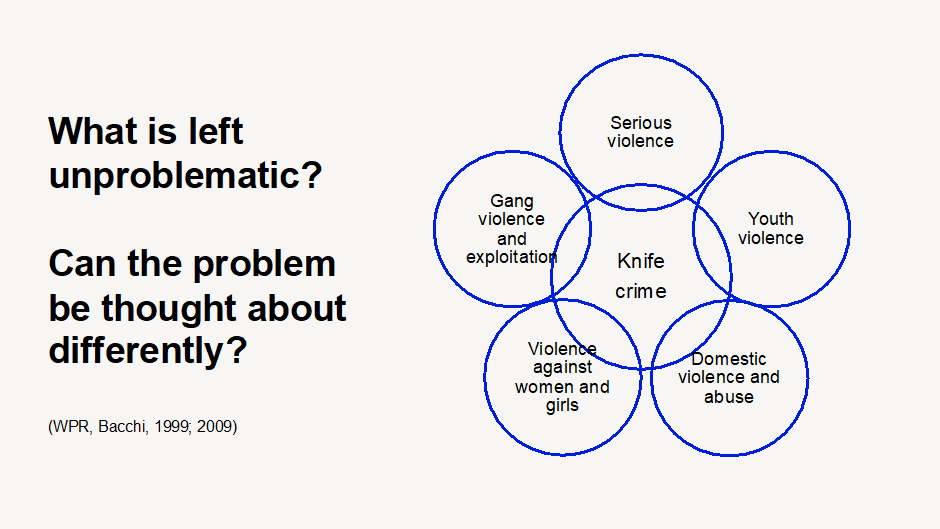
Knife crime is a policy priority that ranks consistently high on the government agenda, appearing in key strategic areas such as serious violence, ‘gang’ involvement and exploitation, and children, young people, and vulnerability. Cutting across these strategic areas is a particular attention to tackling county lines and the misuse of drugs, restrictions on weapon-carrying and possession, early intervention and prevention programmes with young people, and community partnership responses and safeguarding.

What are the assumptions underpinning these representations?

There are key assumptions that underpin these representations of knife crime in public policy, each linked to specific ideas about:

  • who exactly is at risk,
  • where is considered to be safe,
  • who is vulnerable to harm,
  • and, on the whole, what forms of violence are deemed to be ‘serious’.

Constructions of knife crime as they currently stand, depict the problem as one committed primarily by and against men, occurring in public spaces, often between young people, and as an issue that is increasingly racialised in media and public discourse. The evidence base for each is not to be ignored and there are key takeaways from each policy approach which contribute one piece of a puzzle.

However, taking a WPR approach, there are questions to be asked: What is left unproblematic and what harms and whose voices are missed as a result?

There are key elements that are omitted from current policy approaches to knife crime and lessons to be learned from the violence against women and girls sector which have been relatively absent so far.

What is left unproblematic? Can the problem be thought about differently?

Various sources of evidence highlight that knives are consistently the most frequent method of killing in the context of intimate partner homicide by men against women. While the proportions fluctuate (e.g., ONS 2023; Femicide Census, 2020; VKPP, 2023), it stands that when women are killed by men, they are most likely killed using a knife. 

What effects are produced by this problem representation?

Considering that up to 1 in 3 victims of homicides using a knife are women, it is problematic that there is so little analysis of sex/gender in policy responses (see, MOPAC 2017, for an exception). This has serious implications for how interventions are identified.

For example, efforts to regulate offensive weapons through legislation hit a wall when it comes to domestic abuse committed within the home. There have been several proposals over the years to either blunt kitchen knives or confiscate particular knives in the possession of known domestic abuse perpetrators – the assumption here being that the removal of the weapon is the removal of risk. However, the fundamental issue in domestic abuse is that anything is a weapon.

These raise questions about what (or who) is considered to be a source of risk and what can be done to reduce it.

How can we disrupt the problem representation?

While public health approaches to violence frequently invoke the need for multi-agency and partnership working, this must also translate to policy and implementation in strategy as well as practice. This means further work to avoid and break down policy siloes and assumptions in problem representations.

See the article, free to access, here:

Cook, E. A., & Walklate, S. (2022). Gendered objects and gendered spaces: The invisibilities of ‘knife’ crime. Current Sociology, 70(1), 61-76. https://doi.org/10.1177/0011392120932972

References

Bacchi, C. (1999) Women, Policy and Politics: The construction of policy problems, London: Sage.

Bacchi, C. (2009). Analysing policy: What’s the problem represented to be? Frenchs Forest, NSW: Pearson Australia

Bates, L., Hoeger, K., Nguyen Phan, T.T., Perry, P. and Whitaker, A. (2022) Vulnerability Knowledge and Practice Programme (VKPP) Domestic Homicides and Suspected Victim Suicides 2021-2022: Year 2 Report. Available at: https://www.vkpp.org.uk/assets/Files/Domestic-Homicide-Project-Year-2-Report-December-2022.pdf

HM Government (2018) Serious Violence Strategy. London: HM Government. Available at: https://assets.publishing.service.gov.uk/media/5acb21d140f0b64fed0afd55/serious-violence-strategy.pdf

Long, J., Wertans, E., Harper, K., Brennan, D., Harvey, H., Allen, R. and Elliott, K. (2020) UK Femicides 2009-2018. London: Femicide Census. Available at: https://www.femicidecensus.org/wp-content/uploads/2020/11/Femicide-Census-10-year-report.pdf  

MOPAC (2017) The London Knife Crime Strategy. London: Greater London Authority. Available at: https://www.london.gov.uk/sites/default/files/mopac_knife_crime_strategy_june_2017.pdf 

ONS (2023) Homicide in England and Wales: year ending March 2022. Available at: https://www.ons.gov.uk/peoplepopulationandcommunity/crimeandjustice/articles/homicideinenglandandwales/march2022/pdf

For further information, please contact Lizzie at elizabeth.cook@city.ac.uk