Archives

Exploring violence, inequality, and representation

Reflections from a guest lecture

By Hannah Manzur, VISION Research Fellow

At VISION, we work with a wide range of stakeholders engaged in tackling violence and inequalities in society, from police to specialist services to national policymakers. Yet, as well as established professionals, our work also engages with students and young people through placement programmes, participatory action research, and, critically, through teaching new generations of upcoming researchers, practitioners and policymakers.  

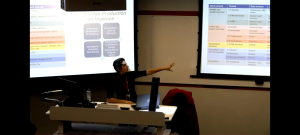
I had the pleasure of joining City St George’s Broken Britain module for undergraduate Sociology and Criminology students as a guest lecturer to share my research and experience on a topic that sits at the heart of my research and professional journey: the relationship between violence, inequality, and the social structures that sustain them. Before joining VISION, I worked as a Policy Advisor at the European Parliament, where I saw firsthand how political decisions, data classifications, and institutional blind spots can shape people’s life chances. Combined with my academic research and civil society work, my career journey has taught me the importance of building bridges and learning lessons from across research, policy, and practice spaces to examine social issues from multiple, interlocking perspectives. Those experiences continue to inform how I teach and think about inequalities and their impact on society today. 
Why Concepts Like Marginalisation and Intersectionality Matter 

I opened the session with a warm-up exercise introducing three foundational concepts: social marginalisationintersectionality, and vulnerabilisation. These ideas help us understand why and how certain groups of people consistently find themselves pushed to the edges of society, excluded from rights, resources, and security.  

In my policy work, these dynamics were impossible to ignore. Decisions that look ‘neutral’ on paper often deepen existing inequalities when viewed through an intersectional lens. Understanding how race, gender, class, sexuality, and migration status interlock isn’t just theoretical—it’s essential for designing policies that do not unintentionally harm the very people they claim to support. By tracing the rich history of intersectionality and how it functions across the individual, interpersonal, and institutional levels of society, students were encouraged to move past surface-level understandings of intersectionality as a buzzword and really engage with the complex ways violence is shaped by intersecting inequalities.  

Everyday Fear and the Unequal Distribution of Safety 

As well as focusing on physical violence, students engaged with wider experiences of violence, including those which directly affected them. One of the most engaging parts of the session involved asking students to reflect on their own relationship with fear and safety: 

  • How often does fear shape your everyday behaviour? 
  • Who feels protected, and by whom? 
  • And whose fears are dismissed or minimised? 

These questions were designed to bring abstract ideas of ‘fear’, ‘security’, and ‘inequality’ to life through student’s experiences navigating the world from their own individual positionalities. Bringing in key insights from my own research at VISION, we discussed the gaps and differences in how violence is understood and experienced from personal and policy perspectives. While working in Brussels, I learned how policymakers often speak about “security” in general terms, yet the lived reality of violence — and fear of violence — is anything but equally shared. Some communities experience over-policing while others receive under-protection; some voices are amplified, others silenced. Understanding this imbalance is crucial for building systems that genuinely keep people safe. 

The Problem of Representation: When Categories Don’t Fit 

From challenging perceptions of violence, we also delved into challenging understanding of ‘inequality’ and how categorising people into distinctive groups can distort our understanding of how different groups experience violence. Official classifications for data collection are often seen as a neutral, technical process. But so much is packed into these decisions. Categorising people, with all their nuance and diversity, into neat separate boxes may be important for creating useful statistics, but it can also create serious problems when these categories don’t reflect people’s lived realities. I displayed some of the categories commonly used in surveys and policy documents and asked students whether these labels reflect their identities or experiences. Students grappled with the contradictions and complexities of capturing inequalities, relating their own frustrations with being put in ‘the wrong box’ and how misrepresentation can carry serious consequences for people’s lived realities being visible and their future life chances. 

This is a conversation that deeply resonates with me. As both a researcher and policy advisory, I often struggled with how overly rigid or simplistic classifications erase nuance, flatten identities, and ultimately limit our ability to recognise and respond to inequality. Data shapes policy—but if the data categories themselves are flawed, so too are the decisions built upon them. Representation is not just symbolic. It determines who is seen, whose experiences are counted, and which forms of violence are acknowledged or ignored. 

Looking Ahead 

My goal in this lecture was not only to share academic insights, but to encourage students to question the systems around them—how they define people, whose realities they prioritise, and how they respond to social harm. Whether in policymaking or research, we cannot address violence and inequality without listening carefully to those who live at their intersections. Drawing on both my policymaking experience and new research findings from my work at VISION, I emphasised the importance of understanding how systems work from multiple perspectives, how cycles of exclusion and harm can feed into one another, and how areas of research, policy, and practice can work together to disrupt these cycles. Engaging with students through this Guest Lecture reminded me of the critical role of teaching in sharing knowledge, changing perspectives, and building critical tools for new generations to see and challenge cycles of inequalities and harm across their future careers and lived experiences.

For further information, please contact Hannah at hannah.manzur.4@citystgeorges.ac.uk

Photographs from Dr Hannah Manzur

Understanding violence: The risks for migrants with rising far-right fascism


Migrant community insights on building safety


By Aya Khedairi, Migrants’ Rights Network


“My dear sister. Please do not lose hope. Better days are coming. ”
– A London workshop participant

“To all migrants: The far rights are out there with their intimidating rhetoric to break you down. You must remain strong and keep hope alive. They are targeting your mental health and they want to destroy it. You must remain resolute and courageous.”
– A London workshop participant

“Do not be afraid, and take care of yourself—for example by going for a walk, talking to someone, or reporting it to the police. My advice is to stay strong.”
– A Belfast workshop participant

Note: The above are messages of solidarity that were shared in our workshops, addressed to other migrants who may be struggling, for the purpose of strengthening community safety. 


In the last few years, there has been a shift in the way that migrants, including refugees and people seeking asylum, are viewed in the UK.  Rhetoric about migration has become more aggressive which has emboldened racist demonstrations in the streets and attacks on asylum accommodation.  

With the support of the UK Prevention Research Partnership (UKPRP) VISION consortium, my colleagues and I at the Migrants’ Rights Network (MRN) are co-developing a research project with migrants that maps experiences of harm and identifies community-led safety strategies. These insights will form a practical workbook featuring shared knowledge, scenarios, and messages of solidarity to all migrants in the UK. 

Our research is centred on two cities, London and Belfast, working with communities who have experience of the asylum system / no recourse to public funds. In Belfast, we were honoured to partner with Anaka Collective/ Participation and the Practice of Rights (PPR), who have been organising and campaigning alongside people seeking asylum since 2016 on a range of topics, including documenting and supporting community members navigating race hate. We built on the research Anaka is already doing through the Kind Economy project to reach new audiences, and further develop community strategies to stay safe. In London, focus group participants shaped the themes and priorities of a subsequent collective knowledge building workshop. 

Our project builds on and brings together MRN’s narrative work, which actively challenges disinformation about migration, while trying to better understand and document the impact of hostile language on people currently in the immigration system.  

Methodology and grounding 

The scale of multifaceted violence migrants in the UK are facing is significant, ranging from the daily indignity of a hostile immigration system that is designed to exclude and push people into poverty and precarity, ever changing immigration rules and relentless government press releases promising to make people feel less welcome in the UK and threatening to remove people.  These are on top of encounters with institutional racism in schools, healthcare and workplaces, and instances of far right violence. In light of this, we took a flexible approach to the research, inviting focus groups and workshops participants to identify key information and research gaps, and topics they would like to prioritise for collective discussion. 

As has come up through discussions, we framed ‘violence’ holistically to include violent narratives, moments of physical violence, and strain of continuous fear of violence, even when no direct violence occurs. 

In anticipation of the weight of some of the topics that might come up, the first focus group was co-designed and facilitated with a somatics practitioner, with grounding, movement and breathing exercises built into the sessions, and an optional online drop-in session the following week. The guiding principle throughout has been a return to shared experiences, mapping and extending individual and community support structures, and affirming participant agency.

Since December, we have hosted two focus groups discussions and a workshop in London, and two sessions in Belfast, with 96 people with lived experience of the asylum system / no recourse to public funds, many of whom are currently, or have previously, lived in asylum accommodation. The London workshops were conducted in English, while the Belfast workshops were primarily facilitated in Arabic, with interpretation into English. 

Key themes

The key findings affirm what we anticipated – the majority of research participants spoke to the impact of increasingly hostile narratives and moments of violence that impacted on their mental health and the ways this has shaped their behaviours. This ranged from choosing to avoid certain areas, being locked into or unable to return to asylum accommodation due to the presence of far right ‘protesters’, checking the news for incidents before leaving home, getting off the bus early and walking to avoid being associated with asylum accommodation and the ‘disgusted looks’ from other passengers, to no longer reading the news. Many participants felt reporting incidents brought little support, citing slow responses, dismissive attitudes, and limited follow-up from police or security staff.

An additional recurring theme from the workshops was the role of minors in perpetrating hate incidents against migrants, whether in schools or in public space. This complicates the ability for bystanders to intervene, and in several experiences recounted in the workshops led to reported hate incidents being dismissed as ‘teenagers being teenagers’. 

However, the overarching theme that emerged, as surmised by one participant, is that “it’s not a feeling of fear, it’s a feeling of rejection”. Others similarly shared that they don’t feel “relaxed, loved in public”, and requested a group discussion on how “others manage fear, uncertainty, or anger in these contexts… especially when formal support systems feel limited or inaccessible”.  The priority emerging from the workshops is the need for more spaces and resources to be heard, the opportunities to share common experiences and the impact these have had, and to be in community. The impact of hostile narratives on mental wellbeing and community participation is a recurring theme in MRN’s work, and one that should trigger significant reflection, accountability and resourcing from policy makers and institutions, as well as allies and the general public. 

Nevertheless, the tone of our research has remained one of anger, defiance and strength. Participants were quick to identify and decry opportunistic politicians and bad faith actors who seek to use migrants as a ‘political card’, with a strong message to politicians to “not use refugees as a tool to win elections. Do not build your success by destroying others”, messages of solidarity to each other to stay strong, and the sharing of wellbeing practices, from calling friends, journaling, or singing. 

London and Belfast workshops

While London and Belfast differ in political context, migrant workshop participants in both cities face racialised hostility. In London, incidents tended to be sporadic and public-facing, whereas in Belfast they were more concentrated, including repeated attacks on specific properties and migrant-owned businesses. As outlined in Committee on the Administration of Justices’ report 2025 report on ‘Mapping Far Right Activity in Northern Ireland’, “it is well documented that there is a particular problem of the involvement of elements of loyalist paramilitarism in racist violence and intimidation, whether sanctioned by leaders of groups or factions or not, or involving persons with paramilitary connections”. This brings additional complications in challenging far right violence and a pattern of ineffective response by the police and local authorities. 

Despite all the differences, there remain striking parallels in experiences and ways of organising that can be extrapolated nationally.  Belfast offers a key reference for the rest of the UK as a precursor of escalations in far-right violence, as well as a leading example of the necessity and strength of having established community and solidarity structures to call on, decompress and celebrate with. In discussing scenarios, the first point of call was always “call Anaka”, whether to come to the house in moments of violence, support with shopping and school runs, or just to connect. 

This research is a small but essential part of shaping MRN’s ongoing work:

MRN would like to thank the UKPRP VISION consortium for the opportunity to develop this work, and to all the participants for their generous insights and reflections. 

For questions or an interest in connecting, please contact Aya at a.khedairi@migrantsrights.org.uk

This project is supported by the UK Prevention Research Partnership (Violence, Health and Society; MR-VO49879/1).

Photograph from Adobe Stock subscription.

The establishment of the National Working Group on Teenage Relationship Abuse

Teenage relationship abuse remains one of the least understood forms of domestic abuse, particularly among those under 16 years of age, who fall outside the statutory definition within the 2021 Domestic Abuse Act.

To close the gap between research, policy, and frontline practice and ensure that young people are no longer overlooked, VISION researcher and co-Deputy Director of the Violence and Society Centre at City St George’s, Dr Ruth Weir, co-established the National Working Group on Teenage Relationship Abuse with Gloucestershire Deputy Chief Constable Katy Barrow-Grint in 2024. The group consists of researchers, practitioners, policymakers, third sector organisations, and young people with lived experience of teenage abuse from across the health and justice sectors for a holistic understanding of the problem.

Membership has grown over the two years and now includes the Home Office, Department for Education, the Cabinet Office, the Domestic Abuse Commissioner’s Office, College of Policing, local government (Islington Council), universities (City St George’s, Essex, Lancashire), NHS bodies, multiple police forces such as Thames Valley and the London Metropolitan Police, school trusts, and charities like SafeLives, Respect, Youth Realities, Changing Relations, and Victim Support just to name a few.

The group brings their expertise to shape ongoing national conversations on how teenage relationship abuse is defined, recognised, and responded to, particularly for those under 16.

Please contact Ruth at ruth.weir@citystgeorges.ac.uk for further information.

Conference: The intersection of public health & violence prevention


Wednesday 4 February 2026, 10 am – 4:30 pm, Leonardo Hotel, Cardiff, CF10 3UD

REGISTRATION NOW OPEN

The UKPRP VISION research consortium and the Violence Prevention team at Public Health Wales are pleased to collaborate on a free, one-day conference, The intersection of public health and violence prevention.

This event will bring together a range of stakeholders working in violence prevention including public health, policing, healthcare, academia, government and the community and voluntary sector. It will showcase professionals from across Wales and beyond who are working at this intersection, with a focus on whole system approaches to violence prevention and the role of public health within this, as well as examining data on violence and its links with health inequalities. Join us for presentations, panel discussions and plenty of opportunities for questions and networking. 

For any questions, please contact VISION_Management_Team@citystgeorges.ac.uk

REGISTRATION NOW OPEN

We look forward to seeing you in Cardiff soon! Violence Prevention Team and VISION Consortium

*******************************************************

COFRESTRU AR AGOR NAWR: Y Croestoriad rhwng Iechyd y Cyhoedd ac Atal Trais

Rydym wrth ein bodd yn eich gwahodd i gynhadledd Croestoriad rhwng Iechyd y Cyhoedd ac Atal Trais, a gynhelir ar y cyd gan Gonsortiwm Trais, Iechyd a Chymdeithas (VISION) Partneriaeth Ymchwil Atal y DU a’r Tîm Atal Trais yn Iechyd Cyhoeddus Cymru.

Pryd: Dydd Mercher 4 Chwefror 2026 10:00am – 4:30pm

Ble: Gwesty Leonardo, Caerdydd, CF10 3UD

COFRESTRWCH YMA

Bydd y gynhadledd undydd, rhad ac am ddim hon yn dwyn ynghyd amrywiaeth o randdeiliaid sy’n gweithio ym maes atal trais gan gynnwys iechyd y cyhoedd, plismona, gofal iechyd, y byd academaidd, y llywodraeth a’r sector cymunedol a gwirfoddol. Bydd yn arddangos gweithwyr proffesiynol o bob cwr o Gymru a thu hwnt sy’n gweithio yn y groesffordd hon, gyda ffocws ar ddulliau system gyfan o atal trais a rôl iechyd y cyhoedd yn hyn, yn ogystal ag archwilio data ar drais a’r cysylltiad rhyngddo ag anghydraddoldebau iechyd.

Ymunwch â ni am gyflwyniadau, trafodaethau panel a digon o gyfleoedd ar gyfer gofyn cwestiynau a rhwydweithio.

Edrychwn ymlaen at eich croesawu ar 4 Chwefror. Anfonwch e-bost at phw.violencepreventionteam@wales.nhs.uk os oes gennych gwestiynau.

COFRESTRWCH YMA

Edrychwn ymlaen at eich gweld yng Nghaerdydd yn fuan! Tîm Atal Trais a Chonsortiwm VISION

Conference programme in English and Welsh to download

Intersection of public health and violence prevention_Programme_E and W

Conference breakout session abstracts in English and Welsh to download

Intersection of public health and violence prevention_Abstracts_E and W

Conference bios of the keynote, chairs and presenters in English and Welsh to download

Intersection of public health and violence prevention_Bios_E and W

Call for Abstracts: The intersection of public health and violence prevention


Opportunity to present at
‘The Intersection of Public Health and Violence Prevention’ conference in 2026

The call is now closed.

The VISION research consortium and the Violence Prevention Team at Public Health Wales are pleased to collaborate on a free, one-day conference. The theme is the intersection of public health and violence prevention in February 2026.

Bringing together a range of stakeholders working in violence prevention including public health, policing, healthcare, academia, government and the community and voluntary sector, we are keen to showcase academics and public health professionals from Wales and beyond who are working at this intersection.

We are currently designing the agenda and are looking for additional participation along these themes:

  1. Exploring or addressing the structural determinants of violence through a public health lens, with a focus on research, policy or partnerships
  2. Sharing innovative, evidence-based practice by highlighting approaches, cross-sector collaboration, or lessons learned that can inform practice, policy, or future research in violence prevention
  3. Exploring the role of lived experience in research and ethical considerations.

Presenters will have a maximum of 20 minutes to present, including time for questions or discussion. We welcome interactive presentations or workshops.

Presentation summaries must be a maximum of 300 words and are due by 17 December at 5 pm. Please email Word documents and any questions to PHW.Violencepreventionteam@wales.nhs.uk

Registration will be open soon and announced on this webpage, via networks, and on the VISION LinkedIn pageFor any questions about registration, please contact VISION_Management_Team@citystgeorges.ac.uk

A Scoping Review: Black and Minoritized Women’s Experiences of Specialist Domestic Violence Services in the UK

Domestic violence and abuse (DVA) harms individuals from all backgrounds, yet the experiences and needs of different communities vary significantly. The Crime Survey for England and Wales (CSEW) estimated that over 1.4 million women and 751,000 men experienced DVA in the year ending March 2023. Black and minoritized women may face heightened vulnerability to DVA due to factors such as socio-economic deprivation, racism, and exposure to specific forms of violence such as so-called honor-based abuse, female genital mutilation or forced marriage.

In addition, minoritized “survivor–victims” of DVA may face intersecting challenges within their socio-political and community context that impede their ability to disclose DVA and may experience social stigma and fears of racism from service providers for example.

This scoping review maps the existing available literature on Black and minoritized women’s experiences with specialist DVA services in the UK to summarize current understanding and identify knowledge gaps.

The research team, comprised of Penelope E. Lowe from University of Roehampton, VISION researchers Sally McManus, Ravi K. Thiara, Estela Capelas Barbosa and Ladan Hashemi, and Pardis Asadi Zeidabadi from City St George’s UoL, and Sumanta Roy of Imkaan and a VISION Advisory Board member, conducted a comprehensive search across multiple databases and gray literature sources. 

Thematic analysis of the findings revealed three main themes: additional service needs, barriers to accessing support, and the pivotal role of “by and for” services. The team concluded that “by and for” services—provided by and for minoritized women—which adopt an intersectional approach are crucial in addressing the unique needs of Black and minoritized “survivor–victims”, particularly in terms of language support, practical assistance, and community-related support. There is a need for more peer-reviewed literature to recognize the role of “by and for” services, using diverse methodologies to support Black and minoritized communities better.

To download the article: Black and Minoritized Women’s Experiences of Specialist Domestic Violence Service in the United Kingdom (UK): A Scoping Review

To cite: Lowe, P. E., McManus, S., Asadi Zeidabadi, P., Thiara, R. K., Roy, S., Capelas Barbosa, E., & Hashemi, L. (2025). Black and Minoritized Women’s Experiences of Specialist Domestic Violence Services in the United Kingdom (UK): A Scoping Review. Trauma, Violence, & Abuse, 0(0).  https://doi.org/10.1177/15248380251335038

For further information, please contact Penelope at penelope.lowe@rutgers.edu

Illustration from Adobe Photo Stock subscription

Centring otherness with migrant women affected by domestic abuse

Victims-survivors with insecure immigration status in the UK are subject to complexities that limit their access to safety, support, and justice. While campaigners have been advocating for more equitable pathways for provision and support over the years, migrant women continue to navigate hostile environments characterised by dehumanising language and anti-migrant bureaucratic systems.

This chapter, written by VISION researcher Dr Olumide Adisa for the book, Otherness in Communication Research: Perspectives in Media, Interpersonal, and Intercultural Communication, reports on how a feminist dialogic approach (characterised by open, inclusive dialogue and a foundational understanding of social, economic, and political equality for women) was used to centre the often ‘silent voices’ of migrant women affected by domestic abuse.

Feminist dialogical approach acknowledges the complexities that characterise the migrant victim’s journey through the system—the relationship between the self-other, in a peculiar hostile environment which views the other as a ‘threat’. Migrant women continue to endure this othering within agencies as they seek safety and support. For example, some professionals conflating ‘foreignness’ with ‘insecure immigration statuses’, when confronted with difference. This theorisation of self and other lends itself to a social justice-oriented practice.

Using different art forms (co-produced with migrant women) and purposeful conversations, attendees were able to encounter migrant women as not a distant ‘other’ whom ‘we’ observe and theorise but as equal partners in the creating and reshaping on knowledge systems on safety, support, and justice.

This chapter draws on quotes from survivors to funnel through a hopeful lingering over otherness that positions migrant women as deserving of consideration and care, and considers empowering aspects about the other that may often be dismissed in professional circles, but nonetheless are important as a protective element of a safety net.

To download the chapter: Centring Otherness with Migrant Women Affected by Domestic Abuse | SpringerLink

To cite: Adisa, O. (2025). Centring Otherness with Migrant Women Affected by Domestic Abuse. In: Magalhaes, L. (eds) Otherness in Communication Research. Palgrave Studies in Otherness and Communication. Palgrave Macmillan, Cham. https://doi.org/10.1007/978-3-031-73788-6_16

For further information, please contact Olumide at olumide.adisa@city.ac.uk

Illustration from Adobe Photo Stock subscription

Mental health service responses to violence: VISION symposia at the European Psychiatric Association

An aim of the VISION programme is to examine the nature and extent of contact that people with experience of violence have with various health and justice services.

Findings on mental health services were presented in a series of symposia at the European Psychiatric Association’s Section on Epidemiology and Social Psychiatry this year.

The first brought together six studies on experiences of violence and adversity and implications for mental health service use. These included King’s College London’s Anjuli Kaul presenting on Sexual Violence in Mental Health Service Users and Sian Oram on Mental Health Treatment Experiences of Minoritised Sexual Violence Survivors, with further contributions from Emma Soneson (Oxford), Maryam Ghasemi (Auckland), and Ladan Hashemi and Sally McManus (both City St George’s).

A second symposium highlighted the value of the Adult Psychiatric Morbidity Survey to violence research, with Sally McManus presenting on Threatening or Obscene Messages from a Partner and Mental Health, Self-harm and Suicidality.

Finally, a third symposium featuring VISION researchers Angus Roberts, Rob Stewart and others and highlighted how natural language processing can be used with information collected in mental health settings. Sharon Sondh (South London and Maudsley NHS Foundation Trust) presented on classifying experiences of violence in mental healthcare records.

The story so far: Co-production in Lambeth

By Elizabeth Cook, Senior Lecturer in Criminology & Sociology at City St George’s, University of London

As the VISION consortium approaches the end of its third year, work continues on consolidating the learning from various large datasets in crime and justice, health, and specialist services.

What we know is that these datasets are structured in different ways, collected by different agencies, and curated for quite different purposes. They represent particular ways of knowing about violence and abuse: they can help to identify patterns (e.g., what determines whether victim-survivors of sexual violence and abuse access support), prevalence (e.g., of workplace bullying and harassment), trends over time, and associations (e.g., between intimate partner violence, suicidality, and self-harm). However, we also know that large datasets struggle to capture the complex, and sometimes messy, realities of violence and abuse experienced by communities, especially those that are marginalised and minoritised.

Peer action research in Lambeth

In Lambeth, working in collaboration with peer researchers has made visible the evidence gaps that emerge at the intersection of multiple systems of inequality, including racism and misogyny.

We are lucky to be partnered with Lambeth Peer Action Collective (LPAC), High Trees and Partisan as part of a peer action research project. The aim of the project is to explore the role that trusted adults and trusted spaces can play in protecting young people from exposure to violence. Currently, there are 11 peer researchers that work as part of the LPAC: a collective of young people and youth organisations campaigning for change in their community. They are supported by High Trees, a Community Development Trust in Tulse Hill, eight partner youth organisations, and Partisan, a Black-led Community Interest Company providing culturally sensitive mental health support.

What has been achieved so far?

The project builds upon research conducted by the previous cohort of LPAC researchers conducted between December 2021 and August 2022. This project identified the impacts of violence on young people in Lambeth and the structural conditions of poverty, housing, education, urban regeneration, and public safety that were experienced unequally across the community.

Developing these findings further, the second cohort of peer researchers have been participating in weekly research training sessions led by High Trees and supported by VISION. The group has been learning everything they need for the next stage: from safeguarding and finances, to developing research questions, critical thinking skills, and how to evaluate research methods. This month, the LPAC researchers are getting ready to put into practice the interview skills that they have been learning each week in preparation for the next stage of the project – recruitment.

There has been amazing progress so far – not only in forming a research question and defining key concepts, but in developing a shared space for researchers to feel like change is possible and to collaborate with others who want the same.

What have we learned?

There are ongoing conversations about how peer action research can work to redress the imbalance between ‘researcher’ and ‘researched.’ These conversations seem even more relevant to research on violence and abuse, where the issue of power is central to both.

So far, the weekly sessions with peer researchers as well as our meetings with High Trees have taught us a lot about how power operates within institutions and the ways that it can be shared if there is a will to share it. This can be reflected in adequate resourcing, decision-making, access, and sharing skills and knowledge. The project has underlined the importance of respect in research: for different forms of expertise, within spaces, and within research relationships. The project has also challenged adult-centric assumptions about what we suppose that young people need to live better lives.

As mentioned previously, this project highlights the evidence gaps that occur at the intersection of multiple inequalities. In doing so, peer action research can also shape how we utilise large datasets, recognising how different social realities are reflected within existing data (or not).

In this sense, this collaboration has also made hyper-visible the question of: what and who is research for? As others have suggested, action research is not so much a methodology, but a way of thinking about research: it is a way of approaching a specific problem through community, participation, and curiosity. It is not necessarily driven by knowing more about something, but by wanting to change something with what you know.

We hope that this research continues in that spirit!

Further information

Do check out the LPAC’s manifesto for change and their previous report!

 Photograph is copyrighted to Lambeth Peer Action Collective and not for use.

Presentations from the 2024 VISION Annual Conference

The presentations from the 3rd VISION annual conference are now available for downloading.

The event was held at Kings College London, Strand campus, on 11 June. The theme was Violence prevention in research and policy: Bridging silos. Keynote speakers, Dr Claudia Garcia-Moreno (World Health Organisation) and Professor Katrin Hohl (City, UoL) considered the changes needed for effective violence prevention from the perspectives of health and justice. Three symposiums highlighted interdisciplinary research from the VISION consortium and partners on:

– Violence against older people: Challenges in research and policy;

– Learning across statutory review practices: Origins, ambitions and future directions; and

– Responding to experiences and expressions of interpersonal violence in the workplace

Approximately 80 academics, central and local government officials, practitioners, and voluntary and community sector organisations attended from a range of health and crime / justice disciplines.

All the slides that could be shared are available below. Please feel free to download.

Photo caption: Symposium 3, ‘Responding to experiences and expressions of interpersonal violence in the workplace’. From left to right: Chair, Dr Olumide Adisa (University of Suffolk) and Panellists Dr Vanessa Gash (City, UoL), Dr Alison Gregory (Alison Gregory Consulting), Catherine Buglass (Employers’ Initiative on Domestic Abuse) and Dr Niels Blom (City, UoL)

Professor Gene Feder, VISION Director – Welcome – 1 download

Keynote Speaker, Dr Claudia Garcia-Moreno – Violence against women: From research to policy and action – 1 download

Symposium 1 – Violence against older people: Challenges in research and policy – 4 downloads (Hourglass, Office for National Statistics, Public Health Wales & VISION)

Symposium 2 – Learning across statutory review practices: Origins, ambitions and future directions – 1 download

Symposium 3 – Responding to experiences and expressions of interpersonal violence in the workplace – 3 downloads (Employers’ Initiative on Domestic Abuse, and 2 from VISION)