Archives

Doing co-analysis justice: Guiding principles

Our inspiration to create principles for co-analysis with those with lived experience of the criminal justice system stemmed from a previous participatory project which prompted conversation about the benefits and challenges of doing co-analysis ‘properly’. This project asked what does best practice look like and how can those with lived experience effectively take part?

Participatory or co-produced research is increasingly common. However, people with lived experience tend to be involved in the earlier and/or latter stages of research projects and less so in the nitty gritty middle stage. Therefore, VISION and Revolving Doors’ staff and lived experience team members collaborated to develop guidelines to inform the co-analysis process. These principles were created to support the flourishing landscape of research involving people with lived experience in the analysis and interpretation of results, equipping teams with guidance to facilitate meaningful and positive co-analysis.

The principles are organised into six themes:

  1. Supporting diversity in co-analysis
  2. Prioritise emotional safety and support
  3. Address power, hierarchy and tokenism to ‘level the playing field’
  4. Relationship building and team dynamics
  5. Training and shared learning
  6. Experiment with creative methods and outputs

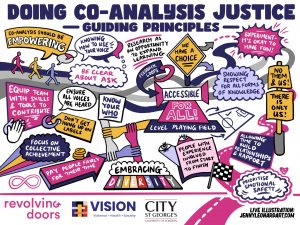
Inspired by this last theme, accompanying the principles is a co-designed illustration that visually represents some of the ideas shared. The image is above and also available for download below.

This resource is for researchers, regardless of background and experience, and practitioners and managers who work with people with lived experience of the issues being studied. The principles will also be useful for those with an interest in teaching or training co-production methods, and anybody involved in the funding or ethical review of research projects embedding lived experience expertise.

We are keen to know how the principles work in practice. If you use them to guide your work, we warmly welcome feedback on how helpful you found them. Please let Annie know at annie.bunce@citystgeorges.ac.uk.

To read the guidance: Doing co-analysis justice: Guiding principles

To find out more about the project: Exploring guiding principles for ‘Doing Co-Analysis Justice’

To find out more about Revolving Doors’ work: Revolving Doors – Breaking the cycle of crisis and crime

With thanks to the following individuals and organisations who co-developed the principles:

  • Revolving Doors: Lauren, Anthony, Charlotte, Charlie, De’Qeon, Jeanette, Leigh, Lucy, Mark, Rimona, Tony and Warren.
  • Dr Annie Bunce, VISION consortium, City St George’s University of London
  • Dr Danica Darley, University of Sheffield
  • Dr Elizabeth (Lizzie) Cook, VISION consortium, City St George’s University of London
  • Dr Les Humphreys, VISION consortium, University of Lancashire
  • Professor Sian Oram, VISION consortium, Kings College London
  • Dr Polina Obolenskaya, VISION consortium, City St George’s University of London
  • Professor Sally McManus, VISION consortium, City St George’s University of London

Illustration from Jenny Leonard Art
Disability and intimate partner violence in England: Gender stratified analyses

By Dr Ladan Hashemi, VISION Senior Research Fellow 

Disabled people are widely recognised as being at heightened risk of gender-based violence, and intimate partner violence (IPV) is one of its most common forms. Yet few prior random probability sample surveys in England have examined the full range of IPV (physical, sexual, psychological, and economic abuse) across different types of impairment, for both women and men. 

Existing research in this area has tended to rely on small, service-based samples rather than the general population, to focus on women only, and to treat “any IPV” as a single outcome rather than distinguishing between different forms of abuse. This matters because different forms of IPV have very different risk profiles and levels of visibility, and because without a general population sample of both genders, it isn’t possible to say whether disability affects men and women’s risk in the same way. 

To address this, together with my co-authors Dr Hannah Manzur, Dr Annie Bunce, and Professor Sally McManus, all VISION researchers, we used the 2014 Adult Psychiatric Morbidity Survey, a nationally representative survey of 7,546 adults in England, to examine the 12-month prevalence of four types of IPV among people with and without four types of impairment: physical health conditions, sensory impairment, learning impairment, and restricted activities of daily living (ADLs). We tested the same disability types and IPV types for men and women, using models adjusted for age, ethnicity, marital status, and socioeconomic factors. 

Disabled women had almost twice the odds of experiencing psychological IPV, and around two and a half times the odds of experiencing sexual IPV, in the past year compared to non-disabled women. No significant difference was found for physical IPV. Women with a learning impairment reported the highest rates of IPV overall (around one in five had experienced some form of abuse in the past year), and women with restricted ADLs were at particularly high risk of economic abuse. For men, using the same measures and models, we found no significant differences in IPV risk between disabled and non-disabled men. 

This gendered pattern is consistent with the wider evidence base on IPV, in which women experience more frequent and more coercive forms of abuse than men, and it suggests that disability compounds this risk specifically for women. Disabled women’s risk was concentrated in the less visible forms of abuse (psychological and sexual, rather than physical), which points to a real gap: safeguarding responses attuned mainly to physical harm may be missing much of what disabled women experience. Isolation, dependency on a partner for care, and barriers to disclosure are all likely to play a part. 

The lack of a significant association for men may reflect several factors. Our sample of disabled men reporting IPV was relatively small, particularly for sexual IPV, which widens the uncertainty around these estimates. Disability may also interact with stigma and barriers to disclosure for men differently than for women, and the broader evidence base on men’s experiences of IPV, disabled or not, remains much thinner than for women. Further research with larger samples of disabled men would help clarify this pattern. 

These findings support investment in violence prevention programmes specifically designed for disabled women, particularly those with learning impairments or multiple impairments, and highlight the need for routes to disclosure that don’t rely on abuse being physically visible. They also point to the importance of coordination between domestic abuse services, disability support services, and health and social care, particularly where a partner also provides care. 

To download the article: Disability and intimate partner violence in England: Gender stratified analyses of a probability sample survey

To cite: Hashemi, L., Manzur, H., Bunce, A. et al. Disability and intimate partner violence in England: Gender stratified analyses of a probability sample survey. BMC Public Health (2026). https://doi.org/10.1186/s12889-026-28489-5

For further information, contact: Ladan at ladan.hashemi@citystgeorges.ac.uk

Photograph from Adobe Photo Stock subscription
