Archives

Doing co-analysis justice: Guiding principles

Our inspiration to create principles for co-analysis with those with lived experience of the criminal justice system stemmed from a previous participatory project which prompted conversation about the benefits and challenges of doing co-analysis ‘properly’. This project asked what does best practice look like and how can those with lived experience effectively take part?

Participatory or co-produced research is increasingly common. However, people with lived experience tend to be involved in the earlier and/or latter stages of research projects and less so in the nitty gritty middle stage. Therefore, VISION and Revolving Doors’ staff and lived experience team members collaborated to develop guidelines to inform the co-analysis process. These principles were created to support the flourishing landscape of research involving people with lived experience in the analysis and interpretation of results, equipping teams with guidance to facilitate meaningful and positive co-analysis.

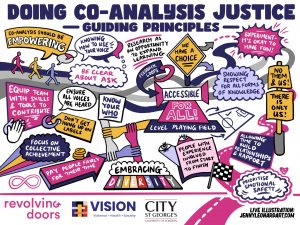
The principles are organised into six themes:

  1. Supporting diversity in co-analysis
  2. Prioritise emotional safety and support
  3. Address power, hierarchy and tokenism to ‘level the playing field’
  4. Relationship building and team dynamics
  5. Training and shared learning
  6. Experiment with creative methods and outputs

Inspired by this last theme, accompanying the principles is a co-designed illustration that visually represents some of the ideas shared. The image is above and also available for download below.

This resource is for researchers, regardless of background and experience, and practitioners and managers who work with people with lived experience of the issues being studied. The principles will also be useful for those with an interest in teaching or training co-production methods, and anybody involved in the funding or ethical review of research projects embedding lived experience expertise.

We are keen to know how the principles work in practice. If you use them to guide your work, we warmly welcome feedback on how helpful you found them. Please let Annie know at annie.bunce@citystgeorges.ac.uk.

To read the guidance: Doing co-analysis justice: Guiding principles

To find out more about the project: Exploring guiding principles for ‘Doing Co-Analysis Justice’

To find out more about Revolving Doors’ work: Revolving Doors – Breaking the cycle of crisis and crime

With thanks to the following individuals and organisations who co-developed the principles:

  • Revolving Doors: Lauren, Anthony, Charlotte, Charlie, De’Qeon, Jeanette, Leigh, Lucy, Mark, Rimona, Tony and Warren.
  • Dr Annie Bunce, VISION consortium, City St George’s University of London
  • Dr Danica Darley, University of Sheffield
  • Dr Elizabeth (Lizzie) Cook, VISION consortium, City St George’s University of London
  • Dr Les Humphreys, VISION consortium, University of Lancashire
  • Professor Sian Oram, VISION consortium, Kings College London
  • Dr Polina Obolenskaya, VISION consortium, City St George’s University of London
  • Professor Sally McManus, VISION consortium, City St George’s University of London

Illustration from Jenny Leonard Art
Exploring guiding principles for ‘Doing Co-Analysis Justice’

Dr Annie Bunce

Blog by Dr Annie Bunce, VISION Research Fellow

How can researchers meaningfully and ethically involve people with lived experience of the criminal justice system in data analysis?

This is the question myself, a group of VISION colleagues (Lizzie Cook, Polina Obolenskaya, Sian Oram, Les Humphreys and Sally McManus), Dani Darley (University of Sheffield) and a group of Revolving Doors’ (Home – Revolving Doors) lived experience members, explored via a face-to-face workshop in May and online feedback session in July, funded by City’s Participatory Research Fund.

Co-production, lived experience engagement, participatory research and patient and public involvement (PPI), amongst others, are increasingly common terms in academia and the wider research landscape. Guidelines and toolkits are popping up for doing participatory research with, for example, children and young people (Participation toolkit | Children and families affected by domestic abuse); survivors of domestic abuse (Review Resources on Survivor Involvement – VAMHN); children and young people in conflict with the law (Golden-Rules-young-people.pdf), and involving those with lived experience in criminal justice reform (PRI_10-point-plan_Lived-experience.pdf).

These broad principles on doing participatory research are useful and have guided my approach to multiple recent projects. But something I noticed is that there is generally less guidance on involving people from marginalised groups, particularly those with lived experience of the criminal justice system, in the data analysis stage of research projects specifically.  Despite the analysis being at the heart of the research process. Essentially, activating the “co” in co-analysis is still somewhat of a mystery. And whilst a definitive “how-to” guide to collaborative data analysis alongside stakeholders would be at odds with the flexibility and relational grounding that are the beauty of co-analysis, a little guidance could make the process smoother and more enjoyable for everybody involved. Without this, quite a lot of angst can be caused repeatedly asking yourselves: Are we trying to do too much? Are we doing enough? How much can we afford to do? How much do people actually want to be involved? How can we make this happen?

Ironically, a fair bit of time in our workshop to co-produce some best practice principles for doing co-analysis was spent going round in circles tackling questions around how to do it. Ultimately, the best approach to co-analysis depends on various factors, including the type of data being analysed, people’s individual experiences and preferences and access to resources etc. Nevertheless, addressing these questions openly and collaboratively, welcoming and respecting everybody’s perspective and actively thinking about all the factors that need to be considered, made for an enlightening and productive discussion. From which themes have been identified and are currently being transformed into principles (watch this space).

A few spoilers:

  • Lots of ‘p’ words are involved, including planning, preferences, perfection, practicality and power
  • Transparency and avoiding tokenism are two of the most important principles for our participants in determining whether they found co-analysis enjoyable or not
  • Ethical standards and institutional processes need reframing if they are to authentically support participatory projects involving co-analysis
  • Co-analysis is messy, heavy and can’t just be squeezed in as an extra; the emotional labour that goes into both managing and participating in co-analysis must be valued
  • Co-analysis can also be fun. People with lived experience want to have fun with it, and it’s nice for them when academics can even have a bit of fun as well

For further information, please contact Annie at annie.bunce@citystgeorges.ac.uk

Photographs:

  1. Top: Post-its from the VISION – Revolving Doors co-analysis workshop
  2. Bottom: Annie Bunce, VISION Research Fellow