Celebrate and Campaign: “Honour”-Based Abuse, Marital Captivity and Housing
By Dr Ladan Hashemi from City St George’s UoL and Arrooj Nawaz, Ghenwa Al Shoumari & Malika Salah from IKWRO
On Tuesday 10 November 2026, approximately 100 delegates gathered at City St George’s, University of London (CSGUL) for IKWRO Women’s Rights Organisation’s conference, Celebrate and Campaign: ‘Honour’-based Abuse, Marital Captivity & Housing.
This year’s event reflected and celebrated the decade-long journey to create the statutory definition of ‘honour’-based abuse (HBA). Delegates also explored what it means in practice for professionals, and shared learnings in best practice campaigning. Alongside celebrating the HBA statutory definition, IKWRO focussed on their two live campaigns: marital captivity, where individuals are trapped in marriages and unable to leave, and the lack of safe housing for those escaping from HBA.
This was the third IKWRO conference hosted by the UKPRP VISION research consortium and the Violence and Society Centre at CSGUL. The event brought together people who rarely share one space: policymakers and Home Office officials, frontline service providers, solicitors, police, students, artists, researchers, campaigners and survivors’ advocates. IKWRO’s annual conference is part of their long-standing commitment to ending VAWG, alongside their advocacy, refuge, counselling, training and campaign work.
A government welcome
Satvir Kaur MP, Minister for Safeguarding and Violence Against Women and Girls, opened the conference with a video address. The Minister expressed the hard-fought efforts and achievements of the by and for organisations to shape the understanding of the statutory definition of HBA. These organisations advised the government on how to understand this complex issue with an intersectional, survivors centred and holistic overview.
IKWRO were pleased to welcome Dame Nicole Jacobs, Domestic Abuse Commissioner for England and Wales. Dame Jacobs acknowledged her longstanding relationship with IKWRO and the importance of grassroots advocacy to inform government policy, and expressed her gratitude to the by and for organisations for their robust and unwavering support to prevent violence against women and girls (VAWG).
Having both the Minister and the Commissioner engage with the day was a strong signal that the issues IKWRO campaigns on are being heard at the highest levels.
Three connected issues
The conference focused on three issues that are closely linked in survivors’ lived experiences:
- Honour-based abuse (HBA): violence and control used to protect a perceived family or community “honour”, often involving several perpetrators and leaving victims isolated from the people around them.
- Marital captivity: when an individual is prevented from leaving an abusive marriage by structural barriers and pressures. These barriers include the immediate family, the wider community, religious institutions and the immigration system.
- Housing: without a safe place to live, many women cannot leave abuse at all. Housing is often the point at which escape becomes possible or impossible. IKWRO highlighted the importance of adequate housing for domestic abuse victim survivors, the sanctuary scheme and special adjustments for women who face HBA.
What we heard
Celebrating a statutory definition of honour-based abuse. Natasha Rattu, Executive Director of Karma Nirvana, traced the survivor-led #Push4Change campaign. Natasha discussed how it started in 2022 when survivors worked with the University of Nottingham to develop a definition of HBA rooted in lived experience. The UK Parliament Women and Equalities Committee backed a statutory definition in 2023, and the government committed to support the bill in 2025. The definition became law through the Crime and Policing Bill, which received royal assent in April 2026.
How a definition becomes law. Hannah Sereni from the Home Office explained the process of drafting a bill. She walked through four stages: building consensus on the core elements of HBA, turning policy into instructions for Parliamentary Counsel, drafting the clauses, and taking them through Parliament. Drafters considered motivation, the connection between victim and perpetrators, patterns of behaviour, and spiritual and faith-based abuse in the bill. Hannah’s lessons for campaigners were fourfold: to bring partners with you; hold on to your non-negotiables; explain every decision; and be ready to compromise.
Marital captivity and the role of religious institutions. Yehudis Fletcher, Founder of Nahamu, spoke about her own experience as a survivor and the role religious institutions can play in keeping women in marriages. She explained why Jewish women are often missing from the discourse and the statistics on marital captivity, forced marriage and honour-based abuse. She also dispelled myths on the subject. Yehudis’ presentation highlighted how control over women extends beyond the family and community and is embedded within religious institutions and structures, exacerbating marital captivity.
Marital Captivity and the role of Immigration. Sulema Jahangir, Partner at Dawson Cornwell LLP, is recognised for her expertise in complex domestic and international family law cases. Sulema has successfully represented many women subjected to HBA, and shared her experience of securing justice for women subjected to transnational abandonment as a form of abuse. She presented how the new provisions for victims of transnational abandonment have helped women return to the UK while stressing that there is still a long way to go in addressing immigration rules that can exacerbate HBA and be weaponised against women. Drawing on real cases, she illustrated the significant challenges of navigating and challenging the immigration system to secure justice for migrant women.
Safe housing for migrant women. Cat Linton, Policy Officer at Hibiscus Initiatives, presented a housing toolkit for professionals supporting Black and minoritised migrant women. The resource details support for women facing housing needs alongside other challenges such as immigration control, criminalisation, VAWG and mental health needs. It names five systemic barriers, including hostile environment policies, reliance on poor-quality shared accommodation and a lack of published data. The toolkit then sets out seven principles for practice, from proactive responsibility to legal literacy and staff wellbeing.
Standards that keep women safe at home. Mark Dowse from Police Crime Prevention Initiatives described how Sanctuary Schemes, which help survivors stay safely in their own homes, have developed since the first scheme in 1998. Standards still vary from area to area. He made the case for a national definition, funding, training and consistent security standards, including for video doorbells and other connected devices. One example made the point: a sanctuary safe room held up against an axe attack until police arrived, and an officer believed it saved the woman’s life. A scheme, Mark stressed, must never give a false sense of security. The talk was concluded by a survivor’s testimony – the scheme helped her to feel safer in her home.
The speakers
The day was led by IKWRO’s CEO, Diana Nammi, and featured:
- Payzee Mahmod, Activist
- Natasha Rattu, Executive Director, Karma Nirvana
- Hannah Sereni, Stalking and ‘Honour’-Based Abuse Policy Lead, Home Office
- Nasima Abukar, Campaigns Manager, IKWRO
- Yehudis Fletcher, Founder of Nahamu
- Sulema Jahangir, Partner, Dawson Cornwell LLP
- Dame Nicole Jacobs, The Domestic Abuse Commissioner
- Ghenwa Al Shoumari, Campaigns Manager, IKWRO
- Cat Linton, Policy Officer, Hibiscus Initiatives
- Mark Dowse, National Secured by Design Sanctuary Scheme Lead, Police Crime Prevention Initiatives
Art as testimony
Alongside the talks, Aida Golzadeh hosted an art exhibition. Aida’s painting and photography reflects how violence imprints itself on the female body, disrupting cycles and reshaping identity. Her work is inspired by a feminist lens and informed by her experience as a woman navigating patriarchal systems. She explores the body as a political and emotional space where memory, trauma, and resistance converge. The work gave attendees another expression of the day’s themes and gave space to survivors’ own expression alongside the policy discussion.
Why this matters for VISION
Partnerships with organisations like IKWRO link VISION’s research on violence, health and inequalities who support survivors every day. VISION has funded a short animation on ‘honour’-based abuse, made in collaboration with IKWRO and created with practitioners’ knowledge at its heart (Link to HBA animation). Events like the IKWRO annual conference ensure that violence prevention evidence reaches the people who shape policy and services, and that in turn research questions are shaped by practitioner and survivor experiences.
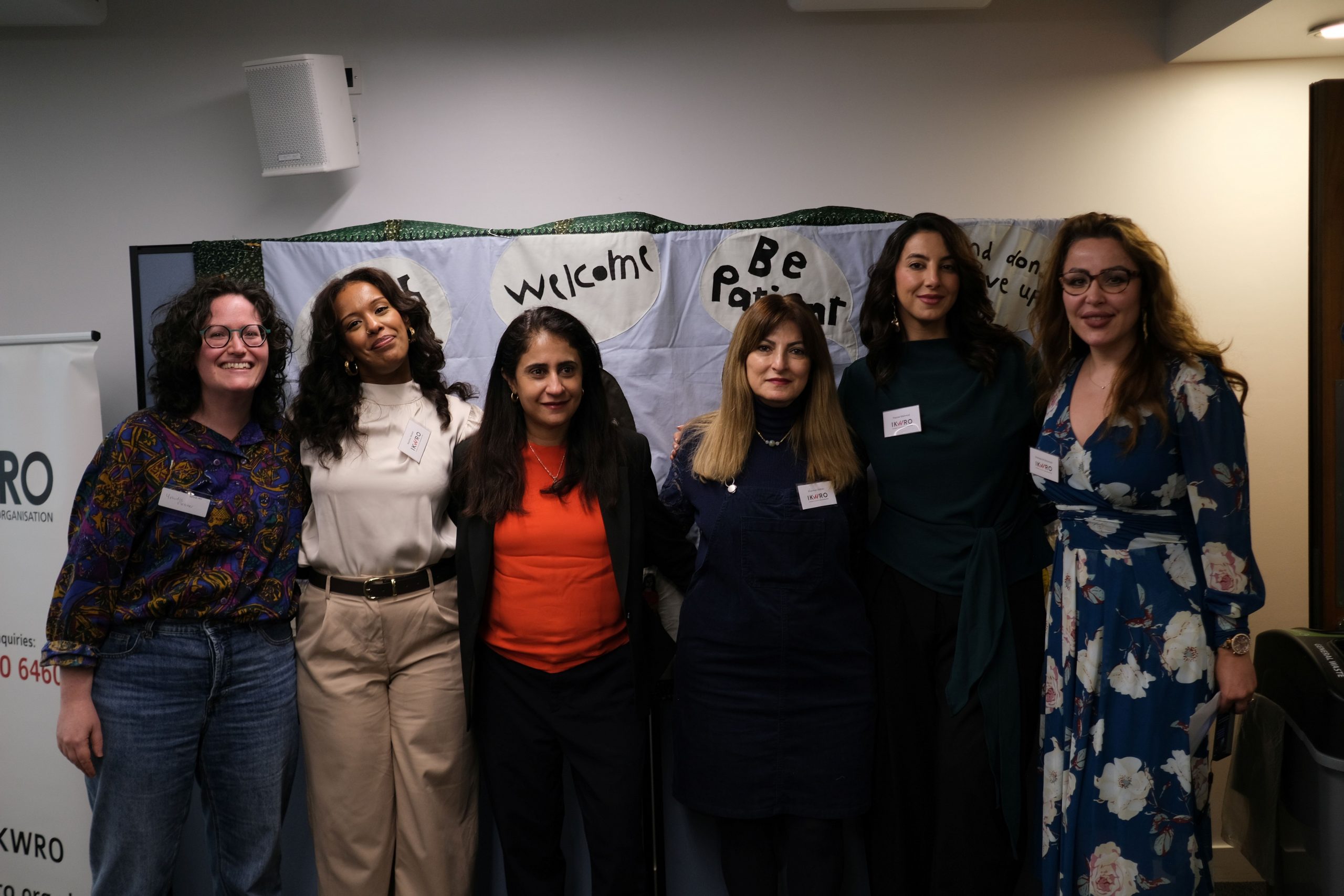
Thank you to everyone who spoke, exhibited, organised and attended. IKWRO also thanks Dr Ladan Hashemi, Kimberly Cullen, CSGUL, the UKPRP VISION consortium and the Violence and Society Centre for hosting for the third year.
Link to IKWRO website
Photographs courtesy of IKWRO and Dr Ladan Hashemi