Doing co-analysis justice: Guiding principles
Our inspiration to create principles for co-analysis with those with lived experience of the criminal justice system stemmed from a previous participatory project which prompted conversation about the benefits and challenges of doing co-analysis ‘properly’. This project asked what does best practice look like and how can those with lived experience effectively take part?
Participatory or co-produced research is increasingly common. However, people with lived experience tend to be involved in the earlier and/or latter stages of research projects and less so in the nitty gritty middle stage. Therefore, VISION and Revolving Doors’ staff and lived experience team members collaborated to develop guidelines to inform the co-analysis process. These principles were created to support the flourishing landscape of research involving people with lived experience in the analysis and interpretation of results, equipping teams with guidance to facilitate meaningful and positive co-analysis.
The principles are organised into six themes:
- Supporting diversity in co-analysis
- Prioritise emotional safety and support
- Address power, hierarchy and tokenism to ‘level the playing field’
- Relationship building and team dynamics
- Training and shared learning
- Experiment with creative methods and outputs
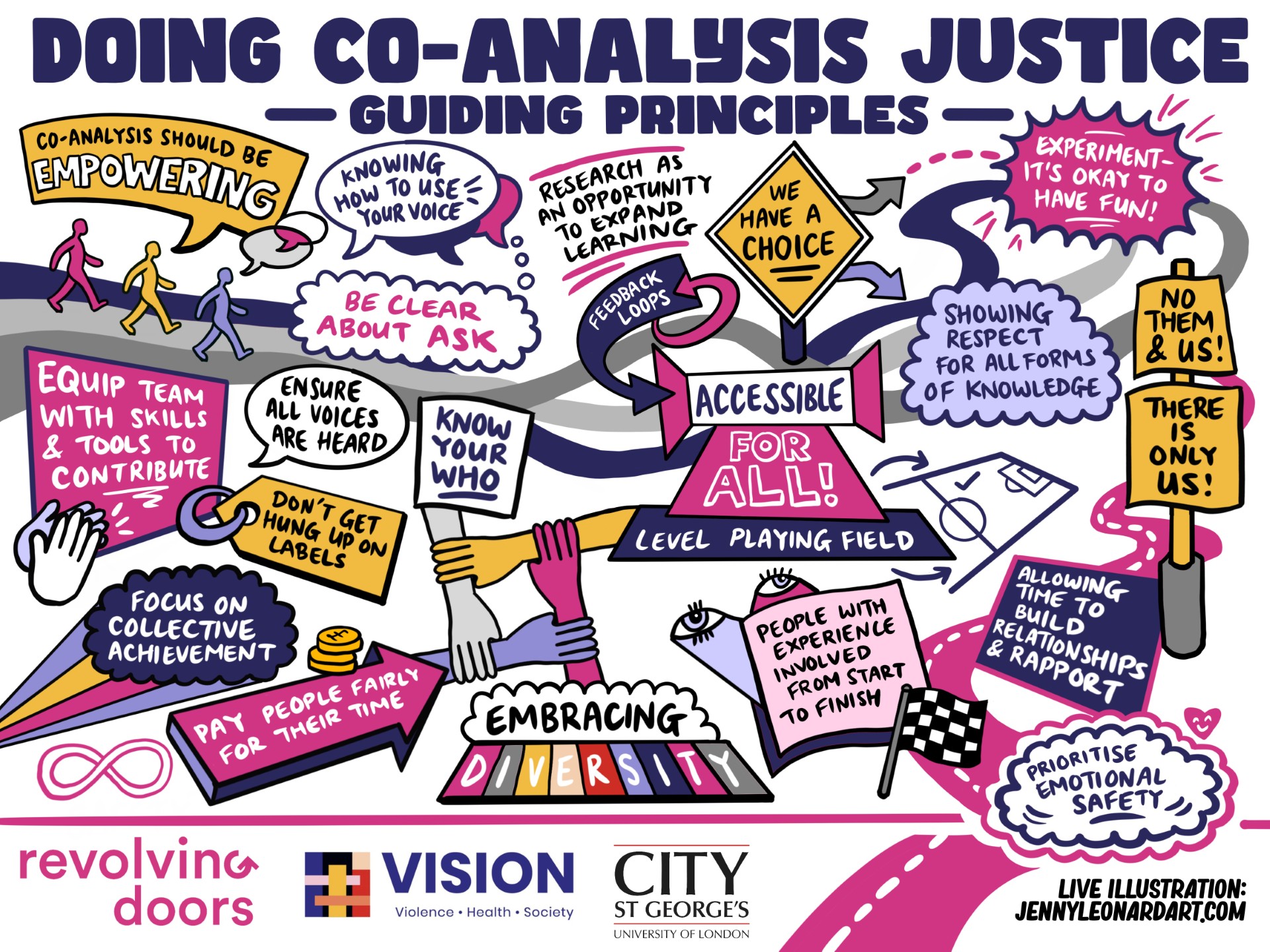
Inspired by this last theme, accompanying the principles is a co-designed illustration that visually represents some of the ideas shared. The image is above and also available for download below.
This resource is for researchers, regardless of background and experience, and practitioners and managers who work with people with lived experience of the issues being studied. The principles will also be useful for those with an interest in teaching or training co-production methods, and anybody involved in the funding or ethical review of research projects embedding lived experience expertise.
We are keen to know how the principles work in practice. If you use them to guide your work, we warmly welcome feedback on how helpful you found them. Please let Annie know at annie.bunce@citystgeorges.ac.uk.
To read the guidance: Doing co-analysis justice: Guiding principles
To find out more about the project: Exploring guiding principles for ‘Doing Co-Analysis Justice’
To find out more about Revolving Doors’ work: Revolving Doors – Breaking the cycle of crisis and crime
With thanks to the following individuals and organisations who co-developed the principles:
- Revolving Doors: Lauren, Anthony, Charlotte, Charlie, De’Qeon, Jeanette, Leigh, Lucy, Mark, Rimona, Tony and Warren.
- Dr Annie Bunce, VISION consortium, City St George’s University of London
- Dr Danica Darley, University of Sheffield
- Dr Elizabeth (Lizzie) Cook, VISION consortium, City St George’s University of London
- Dr Les Humphreys, VISION consortium, University of Lancashire
- Professor Sian Oram, VISION consortium, Kings College London
- Dr Polina Obolenskaya, VISION consortium, City St George’s University of London
- Professor Sally McManus, VISION consortium, City St George’s University of London
Illustration from Jenny Leonard Art