Archives

Perpetrators of domestic abuse against older adults: A rapid evidence assessment

Despite increased research on issues related to aging and older age, abuse of older adults (defined as 60 or over in this study) is a neglected area of academic study. Most of the available evidence is currently found within the elder abuse field; although there is no agreed definition of elder abuse, most incorporate abuse by perpetrators outside of the family (such as carers, people in positions of trust and in some cases strangers) meaning evidence on intimate partner and family member perpetrators is subsumed within these studies. Most studies on domestic abuse have paid limited attention to older age, and in many cases restrict the focus to intimate partner violence among young adults.

PhD student, Merili Pullerits at the Violence and Society Centre at City St George’s University of London, collaborated with colleagues Hannah Bows (Durham University), who led the study, and Natalie Quinn-Walker (University of Wolverhampton), to examine the existing, published research on the demographic and health characteristics, and the offending behaviours and histories of perpetrators of domestic violence and abuse against adults aged 60 and over. 

Using a systematic methodology, searches were conducted in five databases: MEDLINE Complete, APA PsychInfo, CINAHL Complete, SociINDEX with Full Text, Criminal Justice Abstracts with Full Text, and Web of Science (Core Collection), resulting in 75 papers being included in the review.

Their rapid review found that much of the available evidence comes from the elder abuse field, with only a fifth of the included studies taking a specific domestic abuse perspective. Because elder abuse studies often group together all abuse types across varied relationship contexts, such studies make  becomes difficult to extract findings on domestic abuse, potentially hiding important differences. Additionally, the review found that non-intimate partners, that is (adult) children or other family members, tend to be the most frequently reported perpetrator group, although this varied according to the design and methodology of the studies. Most perpetrators tend to be male, and, where information is available, poor health, and drug and alcohol problems are often reported.

The research team concluded that more evidence is required on perpetrators of domestic violence and abuse using a broader range of data sources and research methods.

Recommendation

Evidence on those that use domestic violence and abuse on older people should be situated within the conceptual lens of domestic abuse. Policy and practice should urgently review whether existing risk assessment tools and perpetrator programmes are suitable given that a substantial proportion of domestic abuse against older adults is perpetrated by younger sons, daughters or other family members.

To download: Perpetrators of domestic abuse against older adults – a rapid evidence assessment

To cite: Hannah Bows, Merili Pullerits, Natalie Quinn-Walker, Perpetrators of domestic abuse against older adults – a rapid evidence assessment, Aggression and Violent Behavior, Volume 82, 2025, 102056, ISSN 1359-1789, https://doi.org/10.1016/j.avb.2025.102056.

For further information, please contact Hannah at hannah.bows@durham.ac.uk

Funding: This study was funded by a Home Office (Domestic Abuse Perpetrators) grant.

Photograph licensed under Adobe Stock subscription

Challenges for evidence syntheses on homicide in a global context

Data and evidence on violence are a few of the many core elements necessary for prevention. They inform decision-making by policy makers, provide corroboration for claims-makers, and exist as a means of empowerment for advocates and activists. However, evidence required for prevention is currently fragmented across different systems of knowledge production, creating challenges in the form of missing data.

Viewed through the sociology of quantification and knowledge production, VISION Co-Investigator Dr Elizabeth Cook, provides methodological and ethical reflections on conducting a global systematic review of sex/gender-disaggregated homicide data. In doing so, she highlights epistemological and ontological differences that risk becoming obscured in global, comparative work on violence. 

The systematic review she draws on in her critique, Conflating the map with the territory: Challenges for evidence syntheses on homicide in a global context, consisted of a four-step search strategy: electronic database searches, hand searches of statistics, ministry, and police websites, citation tracking, and email survey of statistics offices.

Studies were included if they reported prevalence data on homicide which was sex/gender-disaggregated (by victim/offender relationship, sexual aspects, and/or motivation) by both women and men. From 194 WHO-recognised countries, data were available for just under half (n = 84). However, there were pronounced differences between countries and regions regarding the availability of data.

Evidence syntheses are just one way of trying to make sense of this vast body of evidence in a transnational context. Viewed through sociological work on quantification and epistemic communities, Lizzie has provided reflections on a global systematic review to establish the prevalence of sex/gender disaggregated homicide by country, region, and globally. 

Recommendation

To avoid conflating the ‘map with the territory’ as others argue, moving towards critical knowledge synthesis as a way to build in contestation and to decenter assumptions of objectivity in the global systematic review of sex/gender-disaggregated homicide data.

To download: Conflating the map with the territory: Challenges for evidence syntheses on homicide in a global context

To cite: Cook, E. A. (2025). Conflating the map with the territory: Challenges for evidence syntheses on homicide in a global context. International Sociology, 0(0)https://doi.org/10.1177/02685809251336694

For further information, please contact Lizzie at elizabeth.cook@citystgeorges.ac.uk

Illustration licensed under Adobe Stock subscription

Confronting violence against vulnerable groups: Insights from a Pint of Social Sciences

On a balmy May evening, VISION researchers Dr Anastasia Fadeeva and Dr Ladan Hashemi had the pleasure of presenting at Pint of Social Science, an engaging public event held at a local pub. The event, organised by Caroline (Cassie) Sipos, Business Development Manager for the School of Policy and Global Affairs, City St George’s University of London, was part of the broader Pint of Science movement.

This event, one of many on the same night, is an annual global festival bringing academic research into informal, accessible spaces such as pubs or cafes. The environment enables researchers and the public to connect over important social issues, drinks, and conversation.

Anastasia showcased her research on violence against older people, an often-overlooked area of abuse and harm. She spoke about different forms of violence in older age, including physical, emotional, and economic, and discussed the social and structural barriers that allow this violence to remain hidden. Anastasia also shared the findings from the recent study that measured the prevalence of violence in older age and the associations between violence and mental health in later life. The talk concluded with calls for stronger protective measures and greater public awareness to safeguard the dignity and wellbeing of older populations.

Ladan shared the Breaking the Silence campaign, which uses culturally sensitive animations to amplify the voices of women in Iran affected by violence. Grounded in a survey of 453 Iranian women, the campaign highlights the widespread and multifaceted nature of violence against women and girls, and the urgent need for greater awareness and legal reform. Through powerful storytelling, the animations address issues such as coercive control, economic abuse, and technology facilitated abuse, while promoting the role of active bystanders and signposting available support services. The campaign aims to break taboos, raise awareness, and foster dialogue about women’s rights and freedoms in Iran.

The evening provided a lively and welcoming space for thoughtful conversations and personal reflections. The audience was engaged with both talks, asking insightful questions—often the kind that don’t come up in professional or academic settings. Pint of Social Sciences was a reminder of the value of public engagement and the importance of making research accessible beyond academia. Events like this help to build understanding and inspire collective action towards a more just and informed society.

For further information, please contact VISION_Management_Team@citystgeorges.ac.uk

Photographs: Top – Dr Anastasia Fadeeva; Above – Dr Ladan Hashemi

Workplace violence and fear of workplace violence: An assessment of prevalence in the UK by industrial sector

Workplace violence is a significant problem with underexamined productivity effects. In a global survey, just under 1 in 5 workers reported exposure to psychological violence and harassment at work, and 1 in 10 reported exposure to physical violence during their working-lives. In the United Kingdom (UK), the Health and Safety Executive (the regulator for workplace health and safety) found 1% of all adults of working age, in the 12 months prior, experienced a physical assault or threat of assault at work.

Workplace violence covers a broad range of adverse social interactions and behaviours committed by or towards employees. It includes encounters between colleagues and between workers and service users. It can also include incidents of domestic abuse experienced at work, with abusers known to pursue victims in the workplace.

Direct and indirect exposure to violent acts or threats of violence at work can be anticipated to lead to anxiety and fear of further victimization. Workplace violence, especially when persistent, may cause psychological disorders including common mental disorders (CMD) of generalized anxiety and depression.

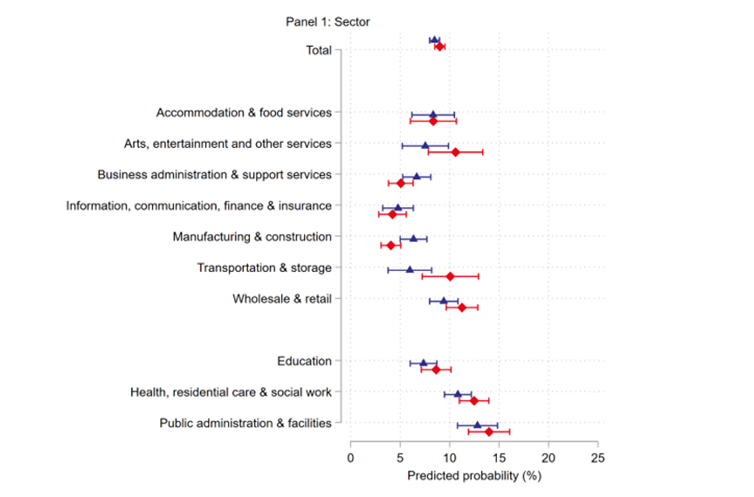
VISION researchers Dr Vanessa Gash (City St George’s University of London) and Dr Niels Blom (University of Manchester) used the United Kingdom Household Panel Study, a nationally representative survey with mental health indicators to examine the prevalence of violence and fear of violence by sector and the effect of violence on common mental disorders (CMD) risk. They also supplemented the analyses with the views of those with lived experience.

Their study, Workplace violence and fear of violence: an assessment of prevalence across industrial sectors and its mental health effects, examined variance in the prevalence of workplace violence and fear of violence in the UK by industrial sector and determined the mental health effects thereof using longitudinal data.

Results showed that a high prevalence of workplace violence and fear of workplace violence was found in multiple different UK industrial sectors – >1 in 10 workers were exposed to violence in the last 12 months in 30% of sectors and >1 in 20 workers were exposed in 70% of sectors. Workers employed in public administration and facilities had the highest risks of workplace violence. The second highest sector was health, residential care, and social work. Workplace violence increased CMD risk as did fear of violence at work. Also, the effect of violence and fear of violence on CMD remained when the researchers investigated CMD one year later. 

Recommendation

The researchers recommend better recognition of the extent to which workplace violence is experienced across multiple sectors and call for better systems wide interventions to mitigate the associated harms.

To download: Workplace violence and fear of violence: an assessment of prevalence across industrial sectors and its mental health effects

To cite: Gash, V, Blom, N. ‘Workplace violence and fear of violence: an assessment of prevalence across industrial sectors and its mental health effects’. Scandinavian Journal of Work, Environment & Health. https://doi.org/10.5271/sjweh.4230

For further information, please contact Vanessa at vanessa.gash.1@citystgeorges.ac.uk

Illustrations from Geisa D’Avo and copyright owned by UKPRP VISION research consortium

Healthcare responding to violence and abuse in Brazil

Domestic violence against women (DVAW) is a public health issue and a breach of human rights, yet evidence on effective interventions remains limited, particularly in low-income and middle-income countries. In Brazil, around one third of women have reported current or previous experiences of DVAW, especially perpetrated by intimate partners. Brazil has a comprehensive policy framework on DVAW, however, their implementation has been piecemeal and low priority.

The research team, led by VISION co-Deputy Director Dr Estela Capelas Barbosa, aimed to evaluate changes in identification and referral to specialist support associated with system-level strategies implemented within Brazilian primary healthcare (PHC) to strengthen the response to DVAW as part of the Healthcare Responding to Violence and Abuse (HERA) programme.

The HERA Programme was an international collaboration, involving research partners in the UK, Brazil, Sri Lanka, Nepal and Palestine, which aimed to strengthen the healthcare system response to DVAW, in order to ultimately ensure better outcomes for women and children.

The researchers explored before and aftereffects using difference-in-difference techniques in a quasi-experimental design, using observational data. HERA intervention in Brazil was implemented in eight PHC clinics, while 33 served as controls. Data on DVAW identification and referral were obtained from the national Epidemiological Surveillance System.

Results indicated that the HERA implementation strategies were effective in increasing identification and referral of women who experienced violence and presented at primary care clinics. By prioritising the needs and experiences of women, under a gender and human rights perspective, the strategies may also have enhanced the quality of interactions between healthcare providers and patients.

To the research team’s knowledge, this is the first Brazilian study using a quasi-experimental design to evaluate a system-level set of implementation strategies to DVAW. It provides compelling evidence for the effectiveness of culturally tailored strategies aimed at improving the response of PHC settings to DVAW. The findings reveal significant improvements in both identification and referral rates. The evidence not only underscores the intervention’s potential but offers a valuable framework for policymakers and healthcare providers seeking to implement effective strategies in similar contexts, particularly in low- and middle-income settings.

To download: Healthcare responding to violence and abuse in Brazil: a quasi-experimental difference-in-differences analysis – ScienceDirect

To cite: Estela Capelas Barbosa, Stephanie Pereira, Loraine J. Bacchus, Manuela Colombini, Gene Feder, Lilia Blima Schraiber, Ana Flávia Pires Lucas d’Oliveira, Healthcare responding to violence and abuse in Brazil: a quasi-experimental difference-in-differences analysis, The Lancet Regional Health – Americas, Volume 47, 2025, 101114, ISSN 2667-193X, https://doi.org/10.1016/j.lana.2025.101114.

For further information, please contact Estela at e.capelasbarbosa@bristol.ac.uk

Photograph from Adobe Photo Stock subscription

The impact of parental intimate partner abuse on young adult relationships

Intimate partner violence and abuse (IPVA) has the potential to be physically and psychologically damaging across generations. Childhood exposure to IPVA may place young people at greater risk of IPVA within their own relationships. It is estimated that a quarter of UK adults have grown up in a household where parental IPVA has taken place.

The research team, including VISION Director Professor Gene Feder and led by Dr Annie Herbert (University of Bristol), aimed to provide estimates for the relationship between IPVA among mothers, and IPVA in their children’s own relationships as young adults.

They studied the intergenerational effects of prospectively-reported IPVA in a UK general population birth cohort and examined effects according to different subtypes of maternal IPVA victimisation (psychological [and to an extent, controlling behaviours], and physical) and young adult IPVA victimisation and perpetration (psychological [including controlling behaviours], physical, and sexual). This is the first prospective longitudinal study on intergenerational effects of IPVA in the UK.

The researchers found a modest association between maternal IPVA (partner-to-mother victimisation) and IPVA victimisation among their children as young adult women, and between maternal IPVA and IPVA perpetration in young adult men.  After adjusting for potential confounding factors, the association for victimisation among women lessened, but a weak positive association for perpetration among young men remained. This finding was consistent with some previous reviews of studies on intergenerational effects of IPVA. The strongest association was for perpetration by men growing up around physical IPVA victimisation.

The findings showed that maternal IPVA victimisation is responsible for up to 10% of cases of IPVA in young adult relationships, largely concentrated amongst young people who experienced complex adversity including child maltreatment. Services supporting domestic violence cases in families should consider wider trauma, including history of child maltreatment.

To download: The impact of parental intimate partner violence and abuse (IPVA) on young adult relationships: a UK general population cohort study – The Lancet Regional Health – Europe

To cite: The impact of parental intimate partner violence and abuse (IPVA) on young adult relationships: a UK general population cohort study. Herbert, Annie et al. The Lancet Regional Health – Europe, Volume 0, Issue 0, 101278

For further information, please contact Annie at annie.herbert@bristol.ac.uk

Photograph from Adobe Photo Stock subscription

Researching the impact of Black and Asian women leadership within East of England domestic abuse services

The East of England is a region with minimal presence of ‘by and for’ (BFR) domestic abuse (DA) specialist services despite being home to Black and Asian communities. A VISION-funded research project, ‘Nothing about us without us’: Investigating the impact of the leadership of ethnic minority women on domestic abuse service provision in East England’, is exploring the impact of the leadership of Black and Asian women within DA service provision in the region.

As part of the work, researchers Dr Mirna Guha (Anglia Ruskin University) and Dr Katherine Allen (University of Suffolk), hosted a leadership event on 3 April 2025 for racially and culturally diverse women. Held at a venue provided by the City of London police, the event was part of a leadership programme implemented through the HUM (‘Us) : A Place-based Emerging-Leaders Model designed and piloted by Mirna and Katherine to diversify leadership in domestic abuse and sexual violence services. Research aims include ensuring culturally responsive and representative support for minoritised victims-survivors in East England.

Prior to the April event, Mirna and Katherine researched the leadership needs of 19 overstretched frontline practitioners i.e. ‘emerging leaders’ from racialised communities working within White-majority and at times professionally isolating generalist services across Bedfordshire, Suffolk and Cambridgeshire. East England is home to scattered racialised and diasporic communities where women’s leadership in local politics and policymaking is low. Based on this, three events on trauma-informed, culturally responsive and diverse styles of leadership have been co-produced with national DASV experts. Participants were invited to also join a regionally pioneering Community of Practice (CoP).

At the April event in London, 15 emerging leaders from racialised backgrounds gained insights into the strategies, opportunities and challenges of practising culturally and racially representative leadership through an inspiring keynote by Superintendent Jasvinder Kaur, Domestic Abuse Lead at Suffolk Constabulary and co-founder of the National Women of Colour in Policing network. Furthermore, nine Black and racialised women speakers associated with statutory institutions viz. Cambridge City Council and the National Police Chief’s Council.

Voluntary organisations also spoke including Apna Haq in Rotherham, Asian Women’s Resource Centre in London, and Karim Foundation in Cambridge. Others also shared their experiences of navigating rural and predominantly White spaces, and their strategies for claiming space, giving voice to community members and creating opportunities for other culturally and racially diverse women leaders. One notable theme was the pathbreaking role each panellist had assumed during her career, opening (or at times creating) doors for herself and those who followed. Discussions across the day dwelled on temporality and the changing political landscapes as well as place-based challenges linked to rurality.

Overall, the leadership model, including this event and others and the growing leadership CoP, with a current membership of 25 emerging women leaders, aims to address these contextual and temporal challenges by bolstering and diversifying racialised women’s leadership in public services to ensure equity for minoritised victims-survivors.

By laying the groundwork for a regional advisory board through the CoP, the model challenges the epistemic erasure of racially and culturally minoritised women within the design of DASV, and broadly, public services which exacerbate the postcode lottery of services across England and Wales. Inspired by Pawson and Tilley’s (1997)[1] approach to realist evaluation (which seeks to understand what works for whom and in which circumstances) Mirna and Katherine aim to evaluate the impact of the leadership programme and CoP on how emerging leaders navigate specific challenges rooted in specific professional, relational and spatial contexts.


[1] Pawson, R. and Tilley, N., 1997. Realistic evaluation.

For further information, please contact Mirna at mirna.guha@aru.ac.uk

Photograph courtesy of Dr Mirna Guha and Dr Katherine Allen.

Start for Life Outcomes Framework: Identifying candidate indicators

In 2021, the Government in England recognised the importance of supporting parents to give their babies and young children under two years of age the best start in life. There was a public commitment to publish a Start for Life Outcomes Framework. The Department of Health and Social Care in England then commissioned the NIHR Children and Families Policy Research Unit to undertake a five-month rapid responsive study to identify and provide a commentary on candidate indicators for this framework.

The research team, including VISION Deputy Director and Senior Lecturer at University of Bristol, Dr Estela Capelas Barbosa, identified candidate indicators to monitor population health of babies, young children, and their families. The project’s secondary focus generated principles for a framework to monitor service performance for this population. 

They conducted two rapid reviews with systematic searches to identify existing outcomes frameworks and core outcome sets that recommended relevant indicators for monitoring both population health and service performance.

Forty-seven candidate indicators were identified, of which 36 met the priority criteria. Many indicators featured in existing frameworks and had some relevant data already collected at scale in England. However, data were often not reported/available separately for adults or households with children and/or by age of child.

Significant further work is needed to develop frameworks to monitor population-level outcomes for babies or assess the quality of services. Frameworks require a clear purpose and consideration of unintended consequences from focusing on some indicators and not others.

The Public Health Outcomes Framework is already a rich resource with 24 (66%) of the 36 priority
indicators already featuring in some form.

To download the summary and / or report: Start for Life Outcomes Framework: Identifying candidate indicators

Photograph from Adobe Photo Stock subscription

A Scoping Review: Black and Minoritized Women’s Experiences of Specialist Domestic Violence Services in the UK

Domestic violence and abuse (DVA) harms individuals from all backgrounds, yet the experiences and needs of different communities vary significantly. The Crime Survey for England and Wales (CSEW) estimated that over 1.4 million women and 751,000 men experienced DVA in the year ending March 2023. Black and minoritized women may face heightened vulnerability to DVA due to factors such as socio-economic deprivation, racism, and exposure to specific forms of violence such as so-called honor-based abuse, female genital mutilation or forced marriage.

In addition, minoritized “survivor–victims” of DVA may face intersecting challenges within their socio-political and community context that impede their ability to disclose DVA and may experience social stigma and fears of racism from service providers for example.

This scoping review maps the existing available literature on Black and minoritized women’s experiences with specialist DVA services in the UK to summarize current understanding and identify knowledge gaps.

The research team, comprised of Penelope E. Lowe from University of Roehampton, VISION researchers Sally McManus, Ravi K. Thiara, Estela Capelas Barbosa and Ladan Hashemi, and Pardis Asadi Zeidabadi from City St George’s UoL, and Sumanta Roy of Imkaan and a VISION Advisory Board member, conducted a comprehensive search across multiple databases and gray literature sources. 

Thematic analysis of the findings revealed three main themes: additional service needs, barriers to accessing support, and the pivotal role of “by and for” services. The team concluded that “by and for” services—provided by and for minoritized women—which adopt an intersectional approach are crucial in addressing the unique needs of Black and minoritized “survivor–victims”, particularly in terms of language support, practical assistance, and community-related support. There is a need for more peer-reviewed literature to recognize the role of “by and for” services, using diverse methodologies to support Black and minoritized communities better.

To download the article: Black and Minoritized Women’s Experiences of Specialist Domestic Violence Service in the United Kingdom (UK): A Scoping Review

To cite: Lowe, P. E., McManus, S., Asadi Zeidabadi, P., Thiara, R. K., Roy, S., Capelas Barbosa, E., & Hashemi, L. (2025). Black and Minoritized Women’s Experiences of Specialist Domestic Violence Services in the United Kingdom (UK): A Scoping Review. Trauma, Violence, & Abuse, 0(0).  https://doi.org/10.1177/15248380251335038

For further information, please contact Penelope at penelope.lowe@rutgers.edu

Illustration from Adobe Photo Stock subscription

VISION member awarded UKDS Impact Fellow to study violence and mental health impacts in older age

Dr Anastasia Fadeeva

VISION Research Fellow, Dr Anastasia Fadeeva, has been awarded a UK Data Service (UKDS) Fellowship.

Anastasia’s interest and education in medicine increased her awareness of the impact of social determinants on people’s health. This led to an MSc in Public Health at London Metropolitan University followed by a PhD at Northumbria University and a career in health services and public health research.

As a UKDS Fellow, Anastasia will look at the issues of violence in older age, the long-term impacts of violence on mental health, and the lack of reliable data.

For more information about Anastasia and her work, see her blog on the UKDS website or email her at anastasia.fadeeva@citystgeorges.ac.uk.

The UKDS is funded by the UKRI and houses the largest collection of economic, social and population data in the UK. Its Data Impact Fellowship scheme is for early career researchers in the academic or the voluntary, community, and social enterprise (VSCE) sector. The purpose of the programme is to support impact activities stemming from data-enhanced work. For further information on the UK Data Service please see: UK Data Service

Photograph from Adobe Photo Stock subscription