Archives

Impact of verbal abuse as a child just as harmful as physical abuse

Globally, one in six children are estimated to suffer physical abuse within domestic and family relationships. As well as immediate health risks associated with the physical trauma of abuse, physical abuse can have lifelong impacts on mental and physical health and well-being. Thus, even as adults, individuals who have been physically abused as children show higher levels of anxiety and depression as well as more problematic alcohol and drug use.

As a source of toxic stress, verbal abuse, like physical abuse, may affect the neurobiological development of children, leading to immediate and long-term impacts on health and well-being. Like physical abuse, verbal abuse has also been linked with poor mental and physical health outcomes during childhood and across the life course. Increasingly, empirical evidence supports verbal abuse causing damage to child development.

For the study, Comparative relationships between physical and verbal abuse of children, life course mental well-being and trends in exposure: a multi-study secondary analysis of cross-sectional surveys in England and Wales, VISION researcher Professor Mark Bellis and his team, combined data from multiple studies measuring child abuse across England and Wales. They tested the associations with poorer mental well-being across the life course with experiencing physical abuse or verbal abuse as a child individually as well as the impact associated with combined exposure to both abuse types.

Their research showed that exposure to childhood physical or verbal abuse has similar associations with lower mental wellbeing during adulthood. In fact, results identified around a 50% increase in likelihood of low mental wellbeing related to exposure to either form of abuse. With regard to verbal abuse, children who experienced ridicule, threats or humiliation from a parent / guardian have a 64% higher chance of poor mental health as an adult. The researchers also discovered that whilst physical abuse reduces over time, verbal abuse increases.

Verbal abuse may not immediately manifest in ways that catch the attention of bystanders, clinicians, or others in supporting services with a responsibility for safeguarding children. However, as suggested here, some impacts may be no less harmful or protracted. The potential impact of verbal abuse should be better considered in policy, and parenting and child protection interventions. The potential role of childhood verbal abuse in escalating levels of poor mental health among younger age groups needs greater consideration.

Recommendation

Interventions to reduce child abuse, including physical chastisement, should consider both physical and verbal abuse and their individual and combined consequences to life course health.

To download: Comparative relationships between physical and verbal abuse of children, life course mental well-being and trends in exposure: a multi-study secondary analysis of cross-sectional surveys in England and Wales

To cite: Bellis MA, Hughes K, Ford K, et al. Comparative relationships between physical and verbal abuse of children, life course mental well-being and trends in exposure: a multi-study secondary analysis of cross-sectional surveys in England and Wales. BMJ Open 2025;15:e098412. http://doi:10.1136/bmjopen-2024-098412

For further information, please contact Mark at m.a.bellis@ljmu.ac.uk

Illustration from Adobe Stock subscription

Violence in later life: Life course and physical and mental health trajectories

Research has demonstrated that violence is associated with worse health in older age. Most of the evidence, however, comes from cross-sectional studies. Research showing how health changes over time in people who have experienced lifetime violence is very scarce.

To address this gap, VISION researchers, led by Dr Anastasia Fadeeva with colleagues Dr Polina Obolenskaya, Dr Estela Capelas Barbosa, Professor Gene Feder and Professor Sally McManus, used seven waves of data from the English Longitudinal Study of Ageing (ELSA) collected between 2006 and 2019 (waves 3 to 9), to examine the associations between parental physical abuse in childhood and any physical or sexual violence across the life course, with the subsequent changes in depressive symptoms, the likelihood of probable depression, and long-standing limiting illness.

The team used a sample of 6171 participants aged 50 and over who answered all questions about violence exposure in wave 3 of ELSA, while information about their health was collected from wave 3 to 9.

The VISION study provides new evidence that health consequences are sustained throughout later life. Results showed that violence of different kinds predicts poorer physical and mental health in older age. Furthermore, the health disparities between victims and non-victims did not reduce over time. This was evident in both men and women.

The findings highlight the value of implementing violence prevention measures throughout the life course, not only to mitigate immediate consequences of violence and abuse but also to reduce the burden of ill health in older age. The results also underscore the need to identify modifiable risk factors such as violence in order to inform polices aiming to promote healthy ageing. More longitudinal data, including from administrative sources, are needed to further demonstrate the associations between different types of violence and health outcomes as people age.

Recommendation

Healthy aging could be improved by preventing violence across the life course. Reducing and addressing experiences of violence at a younger age could reduce the burden of – and inequalities in – poor health in later life.

To download: Violence across the life course and physical and mental health trajectories in later life: a 13-year population-based cohort study in England

To cite: Anastasia Fadeeva, Polina Obolenskaya, Estela Capelas Barbosa, Gene Feder, Sally McManus, Violence across the life course and physical and mental health trajectories in later life: a 13-year population-based cohort study in England, The Lancet Healthy Longevity, Volume 6, Issue 7, July 2025, 100738 https://doi.org/10.1093/bjc/azaf064

For further information, please contact Anastasia at anastasia.fadeeva@citystgeorges.ac.uk

Photograph from Age Without Limits image library.

Presentations from 2nd VISION annual conference now available

We are pleased to provide the presentations from our 2nd annual conference held 21 September 2023 at Mary Ward House in London. 

The theme was Responding to violence across the life course. Sessions included presentations on childhood and teenage years; working life, poverty & economic impacts; older years; and social inclusion in policy and research. The conference concluded with a panel discussion on violence and complex systems.

Seventy-seven academics, central and local government officials, practitioners, and voluntary and community sector organisations attended from a range of health and crime / justice disciplines.

Please feel free to download the presentations below. Each session is one download.

Photo caption: Dr Ladan Hashemi, Senior Research Fellow at VISION, answers a question after her presentation, ‘Adverse Childhood Experiences and Childhood Obesity:​ Exploring Potential Mediating and Moderating Factors​’

Download the Welcome slides

Download the slides from Session 1 – Childhood and teenage years

Download the slides from Session 2 – Social inclusion in policy & research

Download the slides from Session 3 – Working life, poverty and economic impacts

Download the slides from Session 4 – Older people

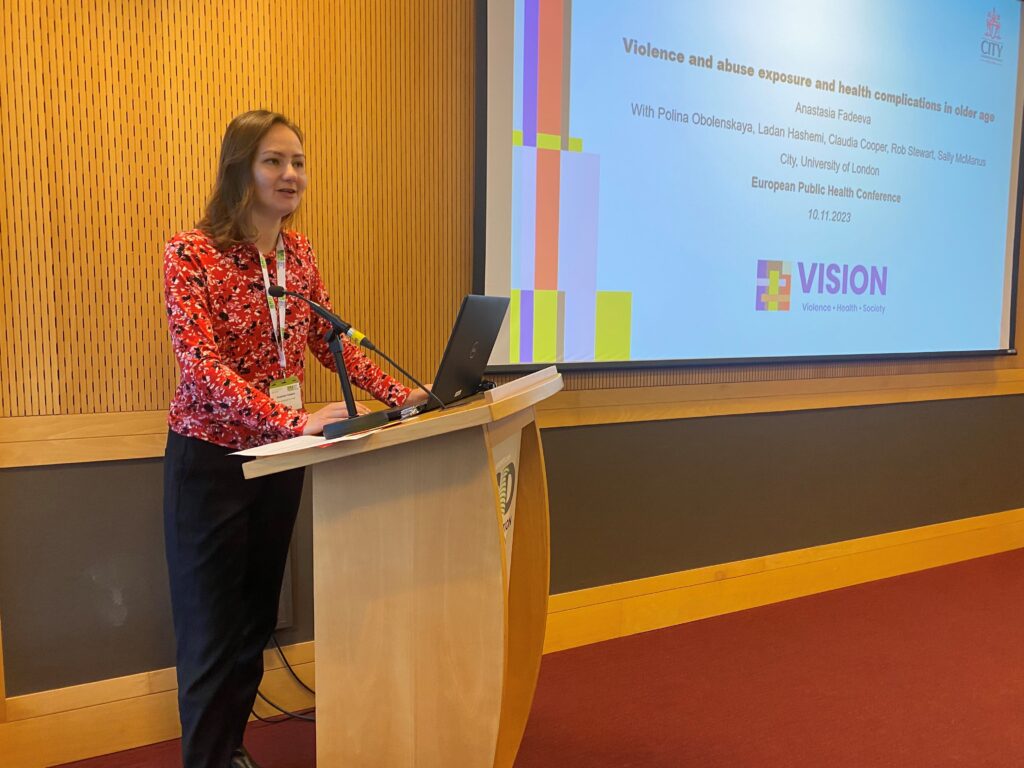
VISION Research Fellow chaired European Public Health Association conference symposium

Dr Anastasia Fadeeva

We’re delighted that one of VISION’s core researchers, Dr Anastasia Fadeeva, chaired a symposium at the upcoming European Public Health Association (EUPHA) conference in November in Dublin.

The workshop, Responding to violence and abuse across the life-course, presented a range of analyses – drawing on data from New Zealand, Germany and the UK – that addressed the ways in which violence and abuse manifest at different life stages, including in childhood, among working-age adults, and in later life.

The presentations highlighted differences across the life course, as well as commonalities. They demonstrated the long-term, even life long, shadow that violence and abuse can cast over people’s health, and provided evidence of the extensive costs for society. Health impacts were shown to be broad, not only anxiety and depression, but substance dependence, chronic physical health conditions, and related health risks such as obesity.

This symposium comprised four presentations that each considered violence and abuse prevalent at a particular stage of life, and provided evidence to inform the sensitive tailoring of responses from and for families, schools, health and social services, workplace human resource employees, and care and residential homes. 

For further information on the conference, please see: 16th European Public Health Conference (ephconference.eu)

Or contact Anastasia at anastasia.fadeeva@city.ac.uk

Photo by Priscilla Du Preez ?? on Unsplash