Archives

Non-intimate femicide in England and Wales: A ‘continua’ approach

A key pledge in the Labour Party’s 2024 election manifesto was to halve violence against women and girls (VAWG) over the next ten years. It is well known that violence and abuse experienced by women and girls incorporates a multitude of contexts outside of (as well as within) family and intimate relationships, therefore, any strategy aimed at significantly reducing VAWG will need to extend beyond the domestic sphere, including lethal violence. Despite important advances in domestic homicide (DH) prevention in recent years, 55 per cent of adult women (16+ years) killed across England and Wales were not categorized as DH.

Dr Caroline Miles (University of Manchester) and VISION Co-Investigator Dr Elizabeth A Cook (City St George’s University of London) specifically address the killing of women and girls outside of family and intimate relationships, referred to here as ‘non-intimate femicide’ (NIF), in their recently published article, Non-intimate femicide in England and Wales: A ‘continua’ approach.

There have been numerous high-profile killings of women and girls by male strangers in the UK over the past few year (for example, Sarah Everard, Sabina Nessa, sisters Nicole Smallman and Bibaa Henry, and three girls, Bebe King, Elsie Dot Stancombe and Alice Dasilva Aguiar killed in Southport). These cases attracted high levels of public attention as is often the outcome of intense media interest in particular femicides. Attracting less media attention are the killings of women and girls by men with whom they are acquainted but not intimately connected to (or in some cases, not recognized as such). There is currently a dearth of data, knowledge and policy aimed at preventing NIF, a problem which Caroline and Elizabeth strive to redress.

The research underpinning this article derives from the first exclusive study of NIF in England and Wales, presenting a statistical analysis of the victim, suspect and incident characteristics for all cases involving women who were killed by non-intimate partners or family members between 2002 and 2022. Using Homicide Index data for England and Wales (2002–2022), the researchers provide original insight into the victim, perpetrator and incident characteristics in NIF cases, and reveal important differences between intimate and NIF, as well as high levels of missing or poorly recorded data. They argue for a more accurate recording of NIF, alongside a ‘continua thinking’ approach to femicide research, which documents the killing of all women and girls across a range of intimate and non-intimate contexts. Caroline and Elizabeth write that by adopting a ‘continua of violence’ approach to femicide, which recognizes how ‘gender links violence at different points on a scale’, a nuanced and inclusive understanding of femicide can be developed that is not restricted to those categorized as ‘intimate’ or ‘domestic’.

If the current UK Labour Government are to succeed in their 2024 pledge to halve VAWG over a ten-year period, it is crucial that they focus on the whole continuum of lethal VAWG, including those killed by strangers and people known to them in some capacity who are not intimate partners or family members. NIF accounts for substantial proportions of female homicide victimization and although a key focus in recent years has been on learning more about the contexts of DH, the pathways leading to and circumstances surrounding the killing of women outside of intimate and kin relationships remain to a large extent unknown. 

Recommendation

Recent work to improve the recording of femicide and measure sex/gender motivations acknowledges some non-intimate contexts of femicide; however, in order to fully understand the gendered contexts of NIF, it is essential to improve the quality of data recording for all forms of femicide and to mainstream sex/gender motivation data collection across the whole continuum of femicide.

To download the paper: Non-intimate femicide in England and Wales: A ‘continua’ approach

To cite: Caroline Miles, Elizabeth A Cook, Non-intimate femicide in England and Wales: A ‘continua’ approach, The British Journal of Criminology, 2026;, azag005, https://doi.org/10.1093/bjc/azag005

For further information: Please contact Elizabeth (Lizzie) at elizabeth.cook@citystgeorges.ac.uk

Illustration from Adobe Stock subscription
Webinar: Exploring Domestic Homicide Review commissioning


Exploring Domestic Homicide Review commissioning

This event is in the past.

Tuesday 24 March 2026, 13:00  – 14:30, online

Durham University’s Centre for Research into Violence and Abuse invites you to an online webinar looking at Domestic Homicide Review (DHR) commissioning.

The project team, Dr Elizabeth Cook (VISION Co-Investigator, City St George’s UoL), Dr James Rowlands (Durham University), and Dr Althea Cribb (Durham University) will share findings from a British Academy / Leverhulme Small Grant funded research project into review notification and commissioning decision-making and identify implications for practice and policy. 

The event will include:

This webinar will be of interest to stakeholders involved in reviews, including practitioners, commissioners, senior managers, policy makers, and researchers. Those affected by domestic homicides and abuse-related deaths, including family, are also welcome to join, as are family advocates. 

Join us at this free online webinar on the 24th March between 1300 and 1430 to hear about the findings findings from this project. 

To book your place, click here.

Confronting violence against vulnerable groups: Insights from a Pint of Social Sciences

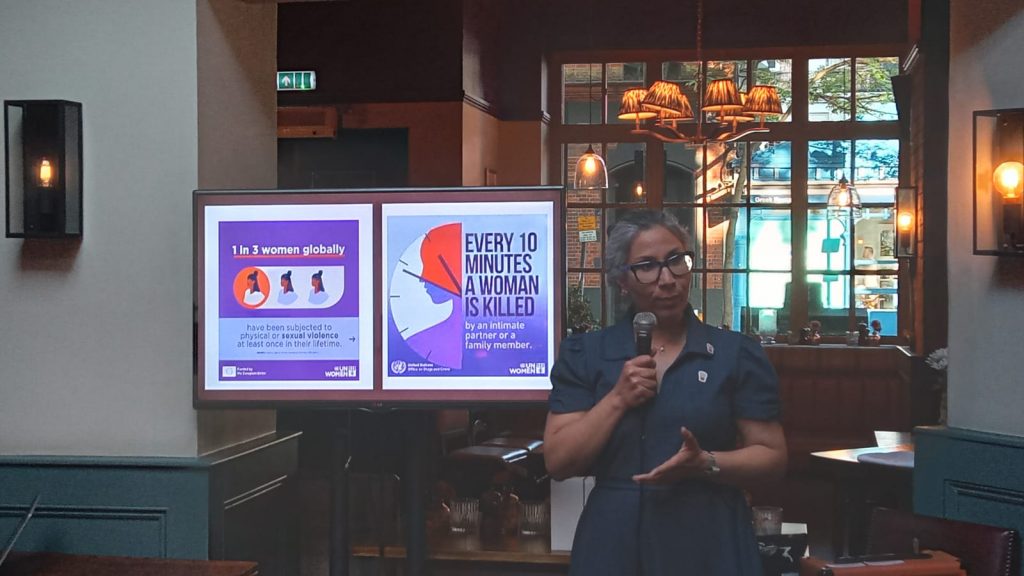
On a balmy May evening, VISION researchers Dr Anastasia Fadeeva and Dr Ladan Hashemi had the pleasure of presenting at Pint of Social Science, an engaging public event held at a local pub. The event, organised by Caroline (Cassie) Sipos, Business Development Manager for the School of Policy and Global Affairs, City St George’s University of London, was part of the broader Pint of Science movement.

This event, one of many on the same night, is an annual global festival bringing academic research into informal, accessible spaces such as pubs or cafes. The environment enables researchers and the public to connect over important social issues, drinks, and conversation.

Anastasia showcased her research on violence against older people, an often-overlooked area of abuse and harm. She spoke about different forms of violence in older age, including physical, emotional, and economic, and discussed the social and structural barriers that allow this violence to remain hidden. Anastasia also shared the findings from the recent study that measured the prevalence of violence in older age and the associations between violence and mental health in later life. The talk concluded with calls for stronger protective measures and greater public awareness to safeguard the dignity and wellbeing of older populations.

Ladan shared the Breaking the Silence campaign, which uses culturally sensitive animations to amplify the voices of women in Iran affected by violence. Grounded in a survey of 453 Iranian women, the campaign highlights the widespread and multifaceted nature of violence against women and girls, and the urgent need for greater awareness and legal reform. Through powerful storytelling, the animations address issues such as coercive control, economic abuse, and technology facilitated abuse, while promoting the role of active bystanders and signposting available support services. The campaign aims to break taboos, raise awareness, and foster dialogue about women’s rights and freedoms in Iran.

The evening provided a lively and welcoming space for thoughtful conversations and personal reflections. The audience was engaged with both talks, asking insightful questions—often the kind that don’t come up in professional or academic settings. Pint of Social Sciences was a reminder of the value of public engagement and the importance of making research accessible beyond academia. Events like this help to build understanding and inspire collective action towards a more just and informed society.

For further information, please contact VISION_Management_Team@citystgeorges.ac.uk

Photographs: Top – Dr Anastasia Fadeeva; Above – Dr Ladan Hashemi

VISION researcher, Lizzie Cook, speaks at Dutch Embassy Just Talk(s) event on femicide

On 10 December 2024, celebrated globally as Human Rights Day and the final day of the 16 Days of Activism against Gender-based Violence campaign, the Dutch Embassy in London organised a panel discussion on femicide and the criminalisation of violence against women and girls.

Lizzie Cook was invited to speak as part of the event which was opened by the Dutch Ambassador Paul Huijts and Liaison Magistrate Wendela Mulder, and moderated by Lotte Wildeboer. The afternoon consisted of talks by Professor Sandra Walklate (of the VISION Advisory Board), Judith van Schoonderwoerd den Bezemer-Wolters (Dutch Public Prosecutor for Domestic and Sexual Violence), Katie Hoeger and Angela Whitaker (VKPP and College of Policing), and Janine Janssen (Dutch Police Academy). The event was part of a series of Just Talk(s) organised by the Dutch Embassy which seek to foster dialogue and exchange ideas on particular issues.

The panel addressed a range of themes including challenges in current definitions of femicide, the implications for data and measurement, and what this means for prevention.

To read more about some of the themes discussed in this panel, do take a look at Lizzie, Sandra and Kate Fitz-Gibbon’s 2023 special subsection of Current Sociology: Re-imagining what counts as femicide which brings together contributions on femicide from the UK, South Africa and Latin America.

Photograph from Adobe Photo Stock subscription