Archives

Employment consequences of intimate partner violence and abuse

Intimate partner violence and abuse (IPVA) is a global problem. Despite its prevalence, few studies have investigated the employment impact of IPVA, with existing studies spread across multiple disciplines including criminology, economics, and public health. Investigating the employment impacts of IPVA are crucial for understanding the consequences to victim-survivors and wider society.

This systematic review, Employment consequences of Intimate Partner Violence and Abuse, conducted by VISION researcher Dr Niels Blom and Flavia Andrea Lamarre, provides an overview of the main findings on the topic and identified research gaps and opportunities for future research.

Niels and Flavia identified studies via Embase, APA PsycInfo, PubMed, Social Sciences Citation Index, and two related reviews. The studies concerned the association between IPVA and absenteeism, time off from work, unemployment, and/or job loss and were peer-reviewed, English-language, quantitative studies. 

Overall, the 48 identified studies indicated a clear relationship between IPVA and absenteeism/time off work, but evidence was more mixed regarding the association between IPVA and job loss or unemployment. The limitations of current research were discussed, which included that the far majority of studies concerned the United States, investigated only victimization among women, and few used nationally representative data. Male victim-survivors, differences by ethnicity or socioeconomic class, perpetration, and how employment circumstances may help or hinder victim-survivors’ labor market involvement had received limited attention in the literature.

Filling these gaps would provide a stronger evidence-base for effective policies, enabling victim-survivors to retain their employment.

Recommendations

  1. Managers and colleagues should have access to training and assistance in aiding victim-survivors where appropriate, potentially with mandatory training for managers and HR staff.
  2. The large majority of studies stemmed from the United States, which makes it less evident whether the found associations also apply to other societal contexts. Cross-national or cross-state research could help.
  3. For a topic where employment is the central aspect, there has been remarkably little attention to employment circumstances and employers’ role. Further research is needed to examine variation across these aspects to understand what enables victim-survivors to retain employment and long-term productivity. 
  4. A minority of the studies included men. Future work could explore what explains gender differences in the employment impact of IPVA, and when they are more pronounced. Differences by race, ethnicity, sexual orientation, gender identity, and age have received limited attention, warranting further research.
  5. There has been a limited amount of work on IPVA perpetrators and their employment. Further work in this area is important.

To cite: Blom, N., & Lamarre, F. A. (2025). Employment Consequences of Intimate Partner Violence and Abuse: A Systematic Review. Trauma, Violence, & Abuse, 0(0). https://doi.org/10.1177/15248380251395105

For further information: Please contact Niels at niels.blom@manchester.ac.uk

Photograph from Adobe Photo Stock subscription
Workplace violence and fear of workplace violence: An assessment of prevalence in the UK by industrial sector

Workplace violence is a significant problem with underexamined productivity effects. In a global survey, just under 1 in 5 workers reported exposure to psychological violence and harassment at work, and 1 in 10 reported exposure to physical violence during their working-lives. In the United Kingdom (UK), the Health and Safety Executive (the regulator for workplace health and safety) found 1% of all adults of working age, in the 12 months prior, experienced a physical assault or threat of assault at work.

Workplace violence covers a broad range of adverse social interactions and behaviours committed by or towards employees. It includes encounters between colleagues and between workers and service users. It can also include incidents of domestic abuse experienced at work, with abusers known to pursue victims in the workplace.

Direct and indirect exposure to violent acts or threats of violence at work can be anticipated to lead to anxiety and fear of further victimization. Workplace violence, especially when persistent, may cause psychological disorders including common mental disorders (CMD) of generalized anxiety and depression.

VISION researchers Dr Vanessa Gash (City St George’s University of London) and Dr Niels Blom (University of Manchester) used the United Kingdom Household Panel Study, a nationally representative survey with mental health indicators to examine the prevalence of violence and fear of violence by sector and the effect of violence on common mental disorders (CMD) risk. They also supplemented the analyses with the views of those with lived experience.

Their study, Workplace violence and fear of violence: an assessment of prevalence across industrial sectors and its mental health effects, examined variance in the prevalence of workplace violence and fear of violence in the UK by industrial sector and determined the mental health effects thereof using longitudinal data.

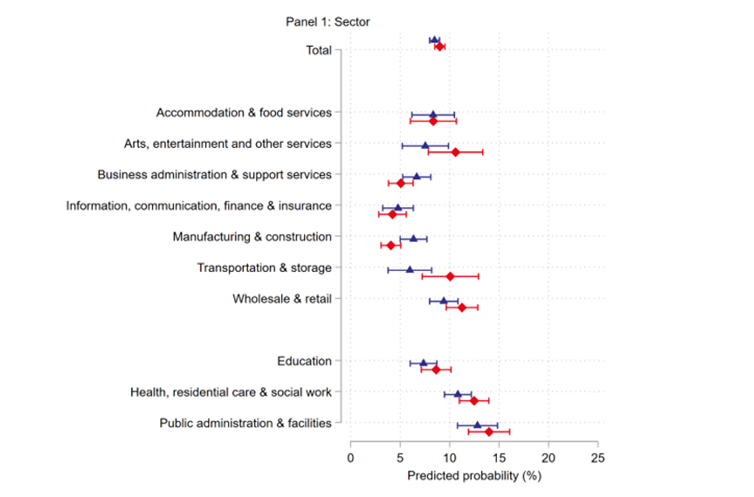
Results showed that a high prevalence of workplace violence and fear of workplace violence was found in multiple different UK industrial sectors – >1 in 10 workers were exposed to violence in the last 12 months in 30% of sectors and >1 in 20 workers were exposed in 70% of sectors. Workers employed in public administration and facilities had the highest risks of workplace violence. The second highest sector was health, residential care, and social work. Workplace violence increased CMD risk as did fear of violence at work. Also, the effect of violence and fear of violence on CMD remained when the researchers investigated CMD one year later. 

Recommendation

The researchers recommend better recognition of the extent to which workplace violence is experienced across multiple sectors and call for better systems wide interventions to mitigate the associated harms.

To download: Workplace violence and fear of violence: an assessment of prevalence across industrial sectors and its mental health effects

To cite: Gash, V, Blom, N. ‘Workplace violence and fear of violence: an assessment of prevalence across industrial sectors and its mental health effects’. Scandinavian Journal of Work, Environment & Health. https://doi.org/10.5271/sjweh.4230

For further information, please contact Vanessa at vanessa.gash.1@citystgeorges.ac.uk

Illustrations from Geisa D’Avo and copyright owned by UKPRP VISION research consortium

Violence in the workplace in the United Kingdom

Our latest research examines two nationally representative datasets, The Commercial Victimisation Survey (CVS) and the UK Household Panel Survey (UKHLS), to examine variance in the prevalence of workplace violence by industrial sector and occupational group.

The authors, Dr Vanessa Gash and Dr Niels Blom, found 28% of commercial businesses reported criminal victimisation on their premises in the past year, including 8% reporting violent victimisation (namely assaults, robberies, and threats).

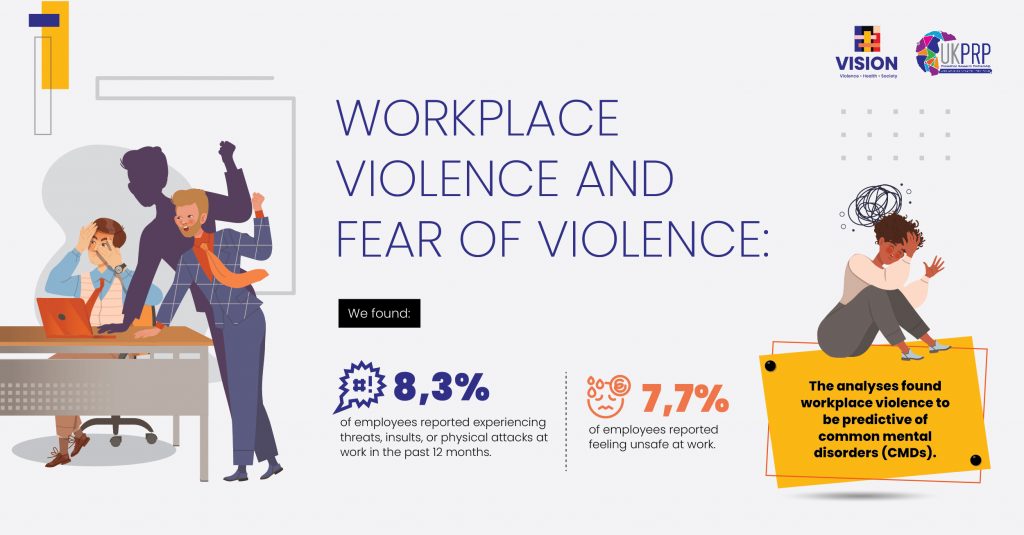
Using individual-level data, the report also found 8% of employees had been threatened, insulted or physically attacked at work in the past year, and a similar percentage have felt unsafe at work, with public sector workers most at risk.

The authors call for enhanced recognition of the problem of workplace violence for a significant proportion of workers in multiple different sectors, alongside improved policies to minimise workplace violence going forward.

Figure 1. Prevalence of Violence and Fear of Violence in the Workplace by Sector, UKHLS data 2020-2021, weighted estimates

The report can be downloaded here: VISION Policy Report – Violence in the workplace in the UK: Business and individual-level exposure

Acknowledgements:

The report benefited from input and insights from the Home Office, who provided us with access to the Commercial Victimisation Survey used here.

Photograph licensed by Adobe Stock

Mental health in the workplace: how employers should respond to domestic violence

This event is in the past.

VISION member Sally McManus will be talking at a Westminster Insight event on Supporting Women’s Health in the Workplace on 20 March 2024.

Sally will use a life-course approach to understanding women’s mental health and wellbeing at work, including the impact of the psychosocial working environment, bullying and harassment at work, and what support and signposting employers can offer in relation to domestic violence.

For further information, please contact Sally at sally.mcmanus@city.ac.uk

Photo by Etty Fidele on Unsplash