Archives

Reducing young people’s exposure to violence in Lambeth

High Trees Community Development Trust and the Lambeth Peer Action Collective (LPAC) were recently awarded further funding from VISION to co-develop an evaluation framework to measure the impact and value for money of open access youth work and provision on reducing young people’s exposure to violence in Lambeth.

The project draws on an existing collaboration and partnership between VISION, High Trees and LPAC that explored the role trusted adults and safe spaces play in protecting young people from violence. The findings from the original partnership support emerging national data about the role that youth organisations, positive activities and trusted adults play in supporting vulnerable young people. However, existing approaches to evaluation surface challenges about how youth work is measured, monitored and evaluated. Through previous LPAC research with young people, youth practitioners and organisations, the team observed a disconnect between how practice is recognised and valued by young people and how funders, commissioners and policymakers expect impact and value for money to be measured.

This contributes to gaps in the quality, consistency and reliability in evidence, particularly as smaller youth organisations have limited capacity and resources to contribute to large-scale evaluations using established methods. For those offering open access youth work and services, where provisions can be accessed by young people regardless of background or need, demonstrating impact and value for money proves even more difficult as these interventions are longer-term, open-ended and/or unstructured across different settings.

Therefore, building on the previous LPAC research and an initial Cost-Consequence Analysis (CCA) produced by VISION, the aim of the current project is to co-produce an evaluation framework, including components for economic evaluation, that supports youth organisations in Lambeth to measure and demonstrate the impact (and potential value for money) of youth service provision.

For further information on the original research, please see the blog, The story so far: Co-production in Lambeth

For further information, please contact Lizzie at elizabeth.cook@citystgeorges.ac.uk

Practitioner in Residence: Improving services for those experiencing teenage relationship abuse

Aisling Barker

Aisling Barker, Violence Against Women and Girls Workforce Development manager at Islington Council, and qualified social worker, is the latest practitioner to join the City St George’s University of London (CSGUL) Practitioner in Residence programme. She became aware of the programme through her work on teenage relationship abuse with co-Deputy Director of the Violence and Society Centre (VASC) at CSGUL and VISION consortium Senior Research Fellow Dr Ruth Weir.

Aisling and her team in Islington have been supporting professionals in their practice with adolescents for five years. They identified concerning trends in violence and abuse in relationships where the victim was as young as 13 years of age but the person causing harm was also as young as 14 or 15 years old. An alarming lack of support available for these young people was apparent – particularly those who were causing harm to their partners at that young age.

Aisling presented the work of her team at the first conference on Adolescent Domestic Abuse hosted by VISION in April 2024. Driven by curiosity the team began to analyse cases to understand where there were system strengths and gaps. They found knowledge and practice gaps in services responding to young people where there was harm in their relationships. They also found that young people often had good relationships with practitioners such as youth workers, gang workers and youth justice case workers. Identifying an opportunity for practice improvement, Aisling and her team developed a training and support package for services working with young people affected by criminality and offending behaviour. Aisling also presented the findings from their case analysis and a case study at the second National Working Group on Teenage Relationship Abuse roundtable in November 2024 also hosted by VISION.

With the support of Ruth and the VASC and VISION teams, Aisling’s focus as a Practitioner in Residence will be documenting and examining the impact of this training and support package as an innovative approach to the prevention and early intervention on violence against women and girls.

For further information, please contact Ruth at ruth.weir@citystgeorges.ac.uk

Photo supplied through Adobe Stock subscription.

Exploring Better Responses to Teenage Relationship Abuse

Dr Ruth Weir

Blog by Dr Ruth Weir, VISION Senior Research Fellow in Criminology

Between April and July, Gloucestershire Constabulary’s Deputy Chief Constable Katy Barrow-Grint and I led a series of three place-based roundtables in Gloucestershire, Northumbria and Oxford, as part of our ongoing research into teenage relationship abuse (TRA).

The events were supported by VISION colleagues Annie Bunce, Polina Obolenskaya and Julia Sahin, alongside Kat Hadjimatheou, Honorary Senior Fellow at the Violence and Society Centre and Senior Lecturer at University of Essex. Each roundtable brought together a wide range of local practitioners—from policing, social care, education, health, and specialist services—as well as people with lived experience of adolescent domestic abuse or teenage relationship abuse. The aim was to explore what is working locally, where the challenges lie, and what would be needed for the local area to become a national exemplar in responding to TRA.

The level of engagement was striking. Attendance was high across all three sessions, with more than 80 participants in Northumbria alone. Far from being one-off conversations, the roundtables have sparked ongoing collaboration with local working groups already being set up to continue improving multi-agency responses to teenage relationship abuse.

The roundtables also provided a platform for Katy, VISION’s first Practitioner in Residence and now an Honorary Research Fellow, to share early findings from her national survey of police forces’ current responses to teenage relationship abuse. These insights are helping to build a clearer picture of practice across the country and will inform the next stage of research and policy development.

For further information, please contact Ruth at ruth.weir@citystgeorges.ac.uk

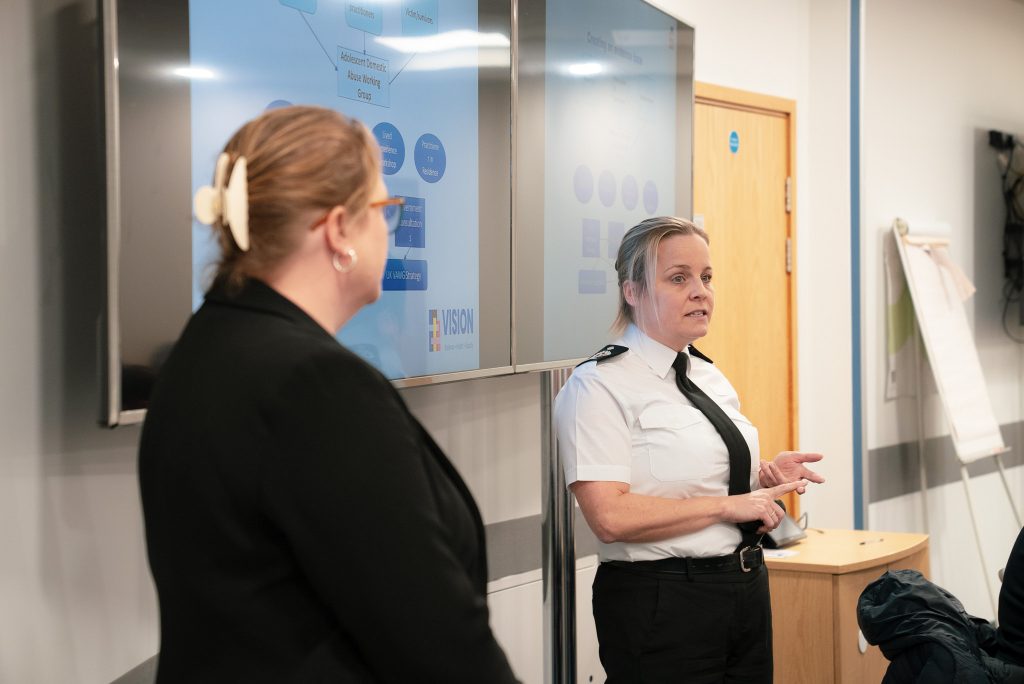
Dr Ruth Weir and Gloucestershire Constabulary’s Deputy Chief Constable Katy Barrow-Grint

Impact of verbal abuse as a child just as harmful as physical abuse

Globally, one in six children are estimated to suffer physical abuse within domestic and family relationships. As well as immediate health risks associated with the physical trauma of abuse, physical abuse can have lifelong impacts on mental and physical health and well-being. Thus, even as adults, individuals who have been physically abused as children show higher levels of anxiety and depression as well as more problematic alcohol and drug use.

As a source of toxic stress, verbal abuse, like physical abuse, may affect the neurobiological development of children, leading to immediate and long-term impacts on health and well-being. Like physical abuse, verbal abuse has also been linked with poor mental and physical health outcomes during childhood and across the life course. Increasingly, empirical evidence supports verbal abuse causing damage to child development.

For the study, Comparative relationships between physical and verbal abuse of children, life course mental well-being and trends in exposure: a multi-study secondary analysis of cross-sectional surveys in England and Wales, VISION researcher Professor Mark Bellis and his team, combined data from multiple studies measuring child abuse across England and Wales. They tested the associations with poorer mental well-being across the life course with experiencing physical abuse or verbal abuse as a child individually as well as the impact associated with combined exposure to both abuse types.

Their research showed that exposure to childhood physical or verbal abuse has similar associations with lower mental wellbeing during adulthood. In fact, results identified around a 50% increase in likelihood of low mental wellbeing related to exposure to either form of abuse. With regard to verbal abuse, children who experienced ridicule, threats or humiliation from a parent / guardian have a 64% higher chance of poor mental health as an adult. The researchers also discovered that whilst physical abuse reduces over time, verbal abuse increases.

Verbal abuse may not immediately manifest in ways that catch the attention of bystanders, clinicians, or others in supporting services with a responsibility for safeguarding children. However, as suggested here, some impacts may be no less harmful or protracted. The potential impact of verbal abuse should be better considered in policy, and parenting and child protection interventions. The potential role of childhood verbal abuse in escalating levels of poor mental health among younger age groups needs greater consideration.

Recommendation

Interventions to reduce child abuse, including physical chastisement, should consider both physical and verbal abuse and their individual and combined consequences to life course health.

To download: Comparative relationships between physical and verbal abuse of children, life course mental well-being and trends in exposure: a multi-study secondary analysis of cross-sectional surveys in England and Wales

To cite: Bellis MA, Hughes K, Ford K, et al. Comparative relationships between physical and verbal abuse of children, life course mental well-being and trends in exposure: a multi-study secondary analysis of cross-sectional surveys in England and Wales. BMJ Open 2025;15:e098412. http://doi:10.1136/bmjopen-2024-098412

For further information, please contact Mark at m.a.bellis@ljmu.ac.uk

Illustration from Adobe Stock subscription

Schools play important role in prevention and early identification of adolescent toxic relationships

VISION researchers, Dr Polina Obolenskaya, Dr Annie Bunce and Dr Ruth Weir, recently published a blog for the London School of Economics (LSE). Breaking the cycle of harm in adolescent relationships looks at the Netflix series, Adolescence, and the portrayal of the reality of teenage violence, and the complex causes behind it.

The researchers draw on their research into adolescent toxic relationships to highlight the sources of such behaviour, and argue that schools can play an important role in prevention and early identification of harmful relationships between peers.

To read or download the blog: Breaking the cycle of harm in adolescent relationships

For further information, please contact Polina at polina.obolenskaya@citystgeorges.ac.uk

Photograph licensed under Adobe Stock subscription

A personal view on the Netflix hit, Adolescence

A Warning for Parents, a Teaching Moment, or Just a Drama?

by City St George’s UoL doctoral researcher Sylwia Wypyska-Kieran

I finally got around to watching the show. I braced myself for it. I work in this field, and when I sit down to watch TV, I want an escape. And more importantly, I have a son the same age as the main character. I was scared—I know how dramas can pull the right emotional strings to shake you to your core. And this show does exactly that.

It grips the audience, tapping into their deepest emotions to climb the charts. It spreads fear about youth violence, fueling the anxieties of parents who are already overwhelmed by the mysteries of the online world. At the school gates, friends tell me how upsetting it was. Online, acquaintances share tips on how to ‘better control’ our children, while colleagues publish their expert opinions. Following the discourse surrounding the show is fascinating. But let’s start from the beginning.

Katie was murdered. In a typical narrative about crime, the show’s focus is on the perpetrator – a 13-year-old boy. This compelling drama has done an amazing job of avoiding the othering of the boy who killed, a common and widely criticised practice in the media. Jamie looks young and innocent. His child-looking face shatters the stereotype of a perpetrator, which is so important for society’s understanding of the reality of everyday violence. We feel for him. We see a child whose life has crumbled. We feel for his parents, we feel their pain, self-blame and disbelief. Together with the detectives, we seek the answers. Why?

I was expecting the answer to be the manosphere. The trailer and discourse surrounding the show heavily focused on that. The online world of incels and Andrew Tates. I was surprised and rather confused to see that the manosphere was not a direct effect on Jamie’s behaviour. Katie was bullying Jamie, calling him an incel and telling him that no one will ever go out with him.

How did a drama about a boy who murdered a girl manage to make her seem responsible for his crime? Whilst I pondered whether I misunderstood the implication, I saw a comment online ‘What the boy did was definitely wrong but didn’t it start from the bullying by the girl!!!’.

The detective’s son pulls his Dad aside and tells him about the secret language of teenagers. I work with some amazing people whose work is all about young people’s participation. Teenagers don’t live on The Planet of the Adolescents, to which we have no access. Yes, adolescence is a distinctive period in people’s lives and we do have to understand the psychosocial challenges young people face. But let’s not align adolescence with violence and let’s not separate ourselves from them. It is harmful to them, to us, and to society as a whole.

‘Adolescence made free for schools as Keir Starmer meets creators’, the BBC reports, alongside calls to introduce anti-misogyny lessons. But we can’t teach our way out of misogyny. It seems like a reactive decision made without consultation with experts or young people. The context, complexities and consequences of this decision could be immense.  

The boys I have spoken to, as part of my research exploring responses to harmful sexual behaviours, have told me that they feel shut down in conversations about relationships and sex. It is consistent with other studies around the topic. They already feel they do not have a space where they can explore and learn about relationships or their identities as men. Will showing this series to them open up a conversation or prove them right? My bet is on the latter. We risk pushing them further into a corner—driving them toward the very spaces where they do feel heard. 

References

Youngs, I. (2025) ‘Adolescence hard to watch as a dad, Starmer tells creators ‘, BBC News, 31 March. Available at: https://www.bbc.co.uk/news/articles/cx28neprdppo (Accessed: 02 April 2025).

Gooch, B., Cooke, M. (2025) ‘Schools to run anti-misogyny classes for boys in bid to tackle toxic masculinity’, The Independent, 25 March. Available at: https://www.independent.co.uk/news/uk/home-news/school-misogyny-classes-boys-toxic-masculinity-adolescence-b2718706.html (Accessed: 04 April 2025)

King-Hill, S (2025) ‘Adolescence in schools: TV show’s portrayal of one boyhood may do more harm than good when used as a teaching tool’, The Conversation, 02 April. Available at: https://theconversation.com/adolescence-in-schools-tv-shows-portrayal-of-one-boyhood-may-do-more-harm-than-good-when-used-as-a-teaching-tool-253158 (Accessed: 02 April 2025).

For further information, please contact Sylwia at sylwia.wypyska-kieran@citystgeorges.ac.uk

Photograph from Adobe Photo Stock subscription

Upcoming event: Weaving Stories of Peer Sexual Abuse 

This event is in the past.

Insights from a youth co-created animation project

Weaving Stories is a pilot animation project developed by County-Durham arts education company, Changing Relations, and funded via the VISION research consortium through the Small Projects Fund.

The animation was co-produced with Secondary-aged students, survivors of peer sexual abuse, and an artistic team, to amplify young people’s voices on the theme of unwanted sexual behaviour and the culture that enables it. The students and young survivors shaped every aspect of the animation.

An interdisciplinary Steering Group of academic researchers, creative practitioners, and child protection and sexual violence specialists from a North East school and Rape Crisis centre, were also involved in the project.

With this animation and associated school based learning programme, Changing Relations seeks to influence knowledge, behaviour, and institutional change using the impactful animation as stimulus for reflection. Following this pilot project, VISION and Changing Relations have organised a one-hour webinar for UK policymakers and practitioners to:

  • Watch the co-created animation (20 minutes)
  • Hear young people’s perspectives on the key themes and co-production approach
  • Explore the animation’s potential impact on school cultures, disclosure, help-seeking, and victim-blaming attitudes
  • Engage in academic-informed analysis of trauma-informed safeguarding and youth-centred approaches to sexual violence prevention
  • Gain practical insights on using creative participatory approaches to engage young people in conversations about violence and abuse
  • Consider actionable recommendations for policy and practice
  • Contribute your reflections

This webinar will be of interest to a wide range of professionals who work with adolescents and / or in violence-prevention. Educators, social workers, academics, and third sector, central and local government policy analysts and researchers in particular may be interested.

There are two dates providing the option to choose between a more practice or policy oriented session:

  • Thursday 8th May 1-2pm for policymakers
  • Wednesday 14th May 3-4pm for practitioners

Speakers and facilitators

  • Lisa Davis, Managing Director, Changing Relations
  • Kate Gorman, Creative Producer and Artistic Director, Changing Relations
  • Kimberly Cullen, Knowledge Exchange Manager, UKPRP VISION research consortium, City St George’s UoL

Webinar registration

To register for free for either the 8th or 14th of May, please visit our page on Ticket Tailor.

The webinar will be on Microsoft Teams and you will receive the link on the day you choose to attend.

For further information, please contact VISION_Management_Team@citystgeorges.ac.uk

The impact and risk factors of adolescent domestic abuse: A rapid systematic review

As a phenomenon, abusive behavior between adolescents in intimate relationships remains relatively invisible, due in part to the persistent yet unfounded assumption that domestic abuse is something that occurs between adults. There is an emerging body of evidence indicating that both victimization and perpetration in intimate partner relationships can and do occur well before adulthood.

This review seeks to improve understandings of intimate partner abuse between adolescents, focusing in particular on younger adolescents below the age of 16 and the impacts and risk and protective factors.

VISION researchers Dr Ruth Weir, Dr Olumide Adisa and Dr Niels Blom, with their collaborators, conducted a rapid systematic review by searching three electronic databases (PsycInfo, Embase, and Social Sciences Citation Index). The team utilized pre-existing systematic reviews to identify relevant primary studies. Findings of the included studies were described and summarized using narrative synthesis.

Seventy-nine studies were identified for inclusion. Synthesis of the findings of these studies identified five categories of risk and protective factors, including bullying and parental intimate partner violence, social and cultural factors, school and neighborhood environment and health and wellbeing. However, the review also identified a gap of qualitative research and a lack of attention to how ADA intersects with cultural factors, gender differences, criminalization, and poor mental health. Many of the studies report on school-based settings, limiting understanding of the role of neighborhood factors in prevention, protection and recovery. Participatory research on help-seeking behaviors of adolescents is rare.

The review synthesized risk and protective factors associated with ADA, especially those occurring between younger adolescents. It highlighted the complex interplay and overlap between using and experiencing violence and abuse and the need for systematic research to inform the development of advocacy, interventions and prevention that is right for young people.

Highlights from the VISION ADA rapid review: Gaps, limitations & considerations for future research

  • Little recent academic interest on ADA in the UK
  • Focus in existing global literature on physical or sexual violence but less so on coercive control or emotional / psychological abuse
  • Lack of systematic examination of long-term consequences of ADA on wellbeing
  • Lack of intersectional analysis (ethnicity, sexual orientation, socioeconomic status, etc)
  • Little exploration of adolescents’ help-seeking behaviours and attitudes to different kinds of possible support
  • Research design limitations

To download the paper: Adolescent Domestic Abuse and Its Consequences: A Rapid Systematic Review | Journal of Family Violence

To cite: Weir, R., Adisa, O., Blom, N. et al. Adolescent Domestic Abuse and Its Consequences: A Rapid Systematic Review. J Fam Viol (2025). https://doi.org/10.1007/s10896-025-00813-4

For more information on this rapid review, please contact Ruth at ruth.weir@city.ac.uk

To view and / or download the list of systematic reviews included in this paper:

Further ADA research across the VISION consortium:

Photo from Adobe Photo Stock subscription

Addressing abuse in teenage relationships

This VISION Policy Brief highlights emerging findings and policy recommendations from ongoing research and stakeholder engagement into abuse in teenage relationships carried out by the UKPRP VISION consortium.

Abuse—whether physical, emotional, or sexual—within young people’s relationships is often overlooked in both research and policy. The Crime Survey for England and Wales (CSEW) finds that young women aged 16 to 19 are more likely to experience domestic abuse than any other age group. Despite this high prevalence, this age group is less likely to be referred to support services. Furthermore, the CSEW does not cover individuals under the age of 16, leaving a major gap in understanding of prevalence.

Key findings:

  • Lack of consistent terminology and recognition – various terms are used to describe abuse in teenage relationships, including ‘teen dating violence’, ‘adolescent domestic abuse’, ‘teenage relationship abuse’ and ‘youth intimate partner violence’. Both the workshop with young people and the roundtables identified that young people generally do not associate the behaviours they experience with any of these terms and are more likely to use language like ‘toxic relationships’.
  • Very limited UK research on risk and protective factors for under 16s – our rapid review found that in the last 10 years there was only one UK academic study that looked into risk and protective factors for abuse in teenage relationships for those aged under 16.
  • Importance of schools and communities – unlike adult domestic abuse, which is largely experienced in private, abuse experienced in teenage relationships is more likely to occur outside of the home, especially within schools.
  • Very difficult to measure extent of issue – due to the current Home Office definition of domestic abuse there is very limited and consistently recorded administrative data collected on those under 16 who are experiencing abuse.
  • Need to take a more radical review of systems – our discussion highlighted the difficulty of addressing abuse in teenage relationships within the current systems.

Recommendations for change:

  • Develop a national strategy – prevention and early intervention
  • Explore support for young people – victims and those carrying out harmful behaviours
  • Commission research into under 16s – including those with lived experience and taking a whole systems approach
  • Improve measurement in under 16s
  • Agree terminology and produce an associated education programme

To download the policy briefing: VISION Policy Brief: Addressing Abuse in Teenage Relationships

To cite: Weir, Ruth; Barrow-Grint, Katy (2025). VISION Policy Brief: Addressing Abuse in Teenage Relationships. City, University of London. Report. https://doi.org/10.25383/city.26539906.v1

For further information, please contact: Ruth at ruth.weir@city.ac.uk

Deputy Chief Constable awarded Practitioner in Residence at Violence and Society Centre

Katy Barrow-Grint, Deputy Chief Constable, Gloucestershire

City St George’s, UoL, offers a Practitioner in Residence programme at the School for Policy and Global Affairs. It is for mid-level and senior policy practitioners within the UK and provides a platform to grow and explore their practice in partnership with the school.

Katy Barrow-Grint, Deputy Chief Constable in Gloucestershire and an executive leader in national policing, became aware of the opportunity via her work with VISION Senior Research Fellow, Dr Ruth Weir,  on the VISION adolescent domestic abuse (ADA) research programme. Having recently written a book entitled ‘Policing Domestic Abuse’ with Ruth and others, the research identified a national gap academically and in policing with how ADA is understood.

Katy’s focus will be on how police constabularies document ADA and developing a better understanding of the impact of the statutory age limitations on the practical work police officers do on the front line.

Forces do not routinely record ADA as the statutory guidance states that domestic abuse occurs in relationships where both parties are aged 16 or over. As a result, whilst crimes against young people will be recorded and investigated, they are not necessarily classified as domestic abuse, and it may be that child protection, domestic abuse or front-line response teams deal with the case.

Her project work will seek to understand how forces are recording such incidents, and what type of officer and role is investigating. Katy will work with policing nationally through the National Police Chief‘s Council (NPCC) domestic abuse and child protection portfolios and collate an up-to-date picture across all forces in England and Wales to understand how they are recording and who is investigating ADA.

Katy is also undertaking specific localised work in Oxfordshire, Gloucestershire and Northumbria, hosting roundtables with Dr Ruth Weir and  practitioners from all relevant agencies to gain a qualitative understanding of the problems staff encounter when dealing with ADA.

Photograph from Adobe Photo Stock subscription