Independent evaluation of Women’s Aid’s ‘Expect Respect’ programme reveals timely learning about effective schools-based health relationship intervention
By Dr Annie Bunce
VISION researchers Dr Annie Bunce (City St Georges University of London) and Dr Estela Capelas Barbosa (University of Bristol), alongside Dr Anna Dowrick (University of Oxford) and Dr Meredith Hawking (Queen Mary University of London), recently wrapped up an independent evaluation of Women’s Aid’s school-based educational programme, ‘Expect Respect’. The programme is aimed at children and young people (ages 4 to 18) and school staff and focuses on unhealthy relationships and the gender stereotypes that underpin them. Sessions are tailored to different age groups, with content for older students also addressing domestic abuse. It is designed to be delivered year-on-year nationally. You can find out more about the programme here: Expect Respect – Women’s Aid
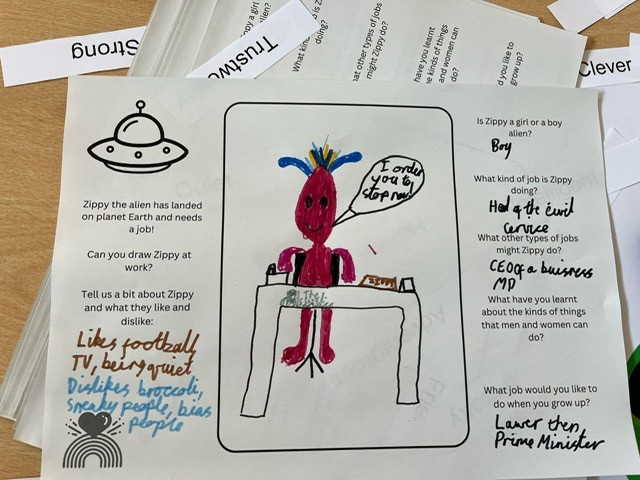
The evaluation was conducted between February 2024 and May 2025, utilising mixed methods to assess the impact of the programme. Staff and student survey data from participating schools was analysed quantitatively, to assess the impact of the programme on individual and school-level behavioural outcomes and differences in student outcomes by age, gender, ethnicity or disability. Creative methods including arts-based activities and vignettes were utilised in student focus groups to facilitate engagement and expression. Interview data from staff and focus group data from students was analysed qualitatively to explore the impact of the programme on school culture, and understanding of and attitudes towards gender stereotypes, healthy relationships and domestic abuse (the latter with older students only).
Findings from quantitative analysis showed that Expect Respect generally works in terms of teaching children and young people about gender roles, healthy relationships and domestic abuse, as well as how and where to seek help. For example, we found the programme had a positive impact on understanding of gender roles among children aged 4 to 14, and on understanding of domestic abuse among older students (ages 11-18). Following the Expect Respect session, those aged 11-18 were less likely to view controlling behaviour as acceptable, and over twice as likely to say they knew who they could talk to if they were concerned about a relationship. School staff overwhelmingly reported they had a better understanding of domestic abuse and felt more confident about responding to abuse-related disclosures after the staff training than they had done beforehand, and were very satisfied with the training. Qualitative findings from staff interviews supported these survey results, with staff describing the content of the training as eye-opening and the delivery by Women’s Aid staff excellent.
Qualitative analysis revealed overall consensus with the quantitative findings in terms of the effectiveness of the Expect Respect training, as well as revealing some nuanced findings. For example, while survey results indicated a change in attitudes for most outcomes immediately following the session, qualitative findings suggested that achieving longer-term change would require consolidation of learning via regular sessions. We also found that secondary school students already had a reasonably decent understanding of the differences between healthy and unhealthy relationship behaviours prior to receiving the Expect Respect session, and felt it would have greater impact if there was a shift in emphasis from awareness raising towards practical advice about how to address unhealthy relationships and where to seek help. There was agreement among both staff and students that the programme would likely have more impact if it was more interactive, particularly the session tailored for older students.
Qualitative findings also suggested that boys found it more difficult to engage with the programme than girls, and both staff and students felt the programme was lacking in information about online relationships. Focus group data highlighted that gender stereotypes remain pervasive in young people’s thinking about heterosexual romantic relationships and are used to justify controlling behaviour. Despite this, staff were optimistic about the potential of the programme to positively impact on both students themselves, and school culture more widely, by planting a seed that they were hopeful would lead to longer term impact. Staff interviews also touched on the challenges of trying to model progressive gender stereotypes and healthy relationships to students through the programme when these were not necessarily reflected among adults in school culture. Nevertheless, staff unanimously felt that the Expect Respect sessions had helped them to identify unhealthy behaviour in relationships between students and also encouraged some students to come forward and speak to them about things they were worried about.
Recommendations
Our recommendation focus on the programme content, format and embedding learning, including:
- Co-produce session content with young people
- Make sessions more interactive
- Utilise the power of personal stories and lived experience
- Explore examples of unhealthy behaviour in friendships, families and romantic relationships
- Focus on sparking conversations and making sessions memorable
- Equip young people with skills to challenge unhealthy relationship behaviour, and linking with local support services
- Continue with year-on-year delivery and provide resources/advice for schools on how to embed Expect Respect messages across the year and build on learning
The full evaluation report can be accessed here: Microsoft Word – ExpectRespect_finalreport_27Jan26
For further information, please contact Annie at annie.bunce@citystgeorges.ac.uk
Cover photo supplied from the evaluation.